Documents for saplings: what to check when buying a lot
Documents for planting material are not a formality but a safeguard for your orchard-establishment budget. We cover what should accompany a wholesale lot of saplings and why each document matters.
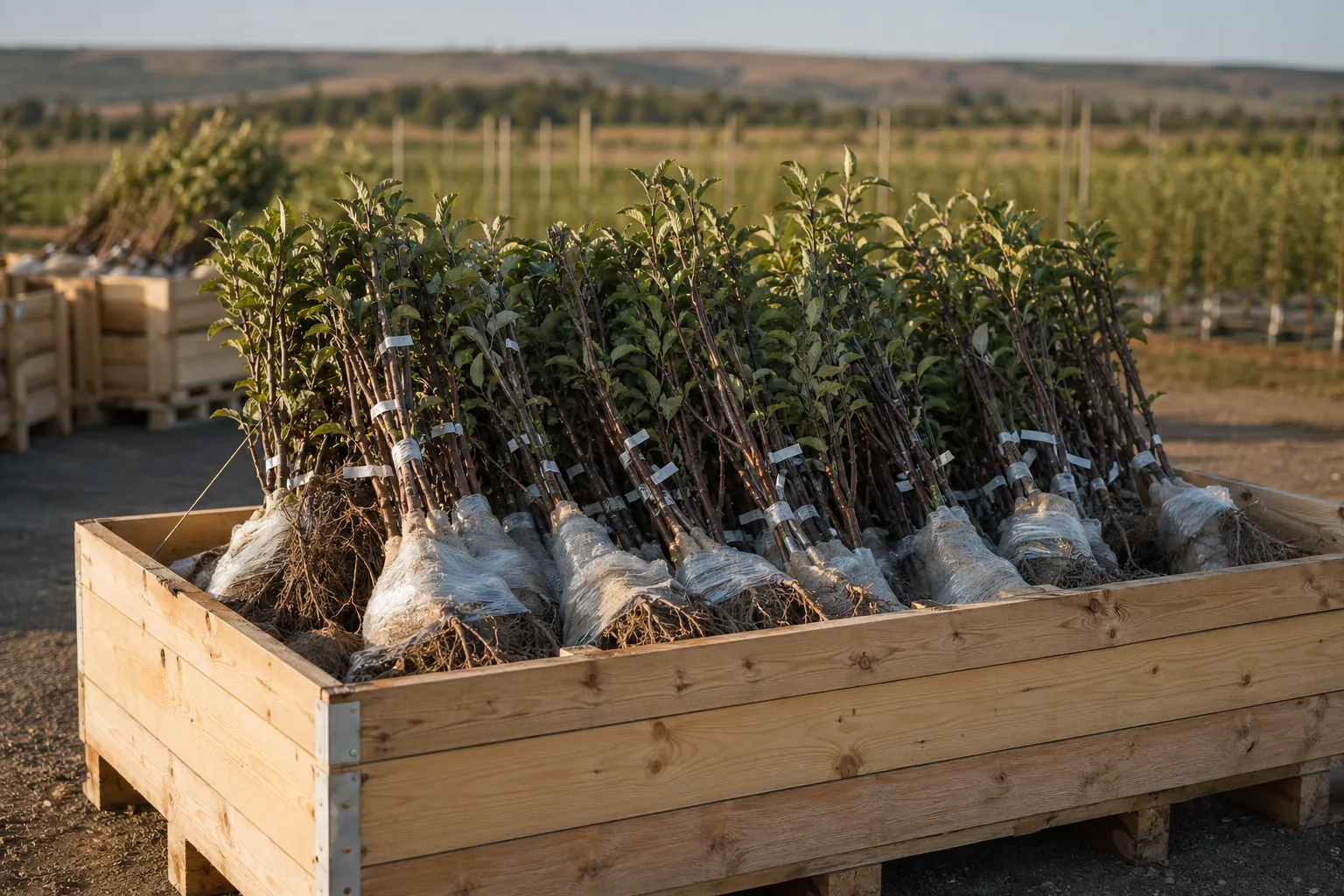
A buyer taking a lot of saplings for several hectares risks more than just the money paid for the planting material. If the lot turns out to carry a cultivar mix-up or an introduced disease, the losses stretch across years: the orchard comes out uneven, some trees have to be grubbed out, and a quarantine pest can close the plot to further shipments. Protection against these risks begins not in the field but at the document-acceptance stage. Let us go through which papers should accompany a lot, what each of them proves, and the signs that reveal an unreliable seller.
Why documents for saplings matter at all
A sapling is a living product whose "quality" is not visible to the eye at loading. A healthy-looking maiden tree may turn out to be the wrong cultivar, be grafted on an unknown rootstock, or carry a hidden infection. Documents for planting material are the only way to verify what cannot be seen: the cultivar identity, the origin and the health status of the lot.
For a commercial orchard this is a matter of direct money. An orchard is planted for 15–20 years, and a mistake in the starting material is multiplied across the whole lifespan. So a sound check of documents is as much a part of establishment as soil preparation or the choice of planting scheme. How we prepare and document each lot is described in detail on the page how we prepare and document a lot.
The phytosanitary and quarantine certificate
The key document for moving planting material between regions is the quarantine (phytosanitary) certificate. It confirms that the lot has been inspected and is free of quarantine pests and diseases, and that it may be moved out of its region of origin. The certificate is issued within the Rosselkhoznadzor system following an inspection of the lot.
Why a buyer needs it. First, it is protection against introducing a quarantine object onto your plot — and therefore against the risk of falling under shipment restrictions yourself. Second, without this document the lot may simply not be cleared for transport to another region. If the planting material is coming to you from another federal subject, a quarantine certificate is not a nice-to-have but a mandatory condition of the deal.
The cultivar certificate and rootstock papers
The quarantine certificate speaks to health status but says nothing about the cultivar. That is the job of the cultivar certificate — a document of cultivar identity confirming that the cultivar and the category of the planting material match what was declared. It rests on field inspection of the mother and nursery plantings, which confirms cultivar trueness. This is your main protection against a cultivar mix-up.
Separately, you should request information on the rootstock and origin: which rootstock the cultivar is grafted on and where the starting material came from. For an intensive orchard this is critical — vigour, the planting scheme and the whole technology depend on the rootstock. A lot labelled "apple, cultivar N" with no rootstock stated does not let you plan the orchard. The same data provide traceability: if something goes wrong in the orchard, you can trace where the material came from.
Need a lot with a full set of documents?
We will prepare saplings with a phytosanitary certificate, a cultivar certificate and rootstock data. We will price a lot for your planting scheme.
Shipping documents and marking
Besides the "quality" documents, a lot is accompanied by shipping documents: a delivery note or a universal transfer document, and an invoice. They record the commercial side of the deal — quantity, cultivar, price and seller — and are needed for accounting, payment and in the event of a dispute. Without them you have no official proof of what was supplied and in what volume.
The lot itself should carry marking — a label or tag with the cultivar and rootstock on the lot or bundle, sometimes together with a lot record. This is what physically ties the papers to the specific plants in the truck: the tag shows that what arrived is exactly what is stated in the delivery note and the cultivar certificate. It is worth checking the marking at acceptance, before unloading.
Which documents there are and what they prove
Let us put it all into one table — a handy checklist for accepting a lot:
| Document | What it proves | Why it matters |
|---|---|---|
| Quarantine (phytosanitary) certificate | The lot is inspected and free of quarantine pests and diseases | Protection against introduced infection; mandatory for transport to another region |
| Cultivar certificate (field inspection) | The cultivar and category of the material match what was declared | Main protection against a cultivar mix-up |
| Information on rootstock and origin | Which rootstock the cultivar is grafted on and where the material came from | Needed for orchard planning and traceability |
| Delivery note / transfer document, invoice | Quantity, cultivar, price, seller | Accounting, payment and proof in case of a dispute |
| Lot marking (label, tag, record) | Cultivar and rootstock on the lot or bundle | Ties the documents to the specific plants |
Our nursery attaches a phytosanitary set of documents to every shipped lot — that is the acceptance standard a buyer is entitled to expect by default. If a seller treats such a set as something unusual, that is already a signal.
Warning signs when buying
There are situations in which it is better not to take a lot, even if the price looks attractive:
The logic is simple: a conscientious nursery prepares documents in advance because for it this is routine. Excuses about "we will send them later" and reluctance to show papers before the deal mean that either there are no documents or something is wrong with them. The money saved on a "lot without papers" almost always turns into far greater losses over the years of the orchard life.
Documents are the last line of checking, but far from the only criterion for choosing a supplier. How to set up the whole purchase — from request to acceptance — we covered in how to buy saplings wholesale, and you can get to know the production on the page about the nursery.
The essentials, in brief.
Which documents should saplings have?
A lot should be accompanied by a quarantine (phytosanitary) certificate, a cultivar certificate, information on the rootstock and origin, shipping documents (a delivery note or transfer document, and an invoice) and lot marking — a tag with the cultivar and rootstock. This set confirms the health status, the cultivar and the commercial side of the supply.Is a quarantine certificate needed for transport to another region?
Yes. For moving planting material between regions a quarantine (phytosanitary) certificate is mandatory: it confirms that the lot is free of quarantine pests and diseases. Without it the lot may not be cleared, and you risk introducing infection onto your plot.What is a cultivar mix-up and how do documents protect against it?
A cultivar mix-up is when a different cultivar, or a mixture of cultivars, is supplied under the name of one. In a commercial orchard this leads to unevenness in timing, calibre and fruit colour. The protection is the cultivar certificate and lot marking: they confirm that the cultivar and category match what was declared.How does a phytosanitary certificate differ from a cultivar certificate?
These documents are about different things. A phytosanitary (quarantine) certificate covers the health status — that the lot is free of pests and diseases. A cultivar certificate covers the cultivar — that you receive exactly the cultivar and category you ordered. You need both.Why is it important to know a sapling rootstock?
The rootstock determines the vigour of the tree, the planting scheme and the whole orchard technology. Without the rootstock stated you can neither plan the planting density nor work out the support and irrigation. In addition, rootstock and origin data provide traceability of the material.Which documents does your nursery provide?
We attach a phytosanitary set of documents to every lot: a quarantine certificate, a cultivar certificate, rootstock and origin data, as well as shipping documents and marking. This is the standard a buyer is entitled to expect by default.
Related material
- 01How to buy saplings wholesale direct from the nurseryA step-by-step guide to ordering saplings wholesale direct from the nursery — from stock list and booking to self-pickup with paperwork — and why a direct supply beats a reseller.Read article
- 02When to plant fruit saplings: spring or autumnAutumn or spring is the perennial question of starting an orchard. We cover how autumn and spring planting of bare-root saplings differ, the risks of each window, and what to choose in southern Russia.Read article
- 03How to choose apple cultivars for a commercial orchardThe cultivar decides who buys your crop and when. We cover the criteria for choosing commercial apple cultivars for an intensive M9 orchard: market, timing, marketability, storage and pollination.Read article
Need saplings for your project?
We will match cultivars and rootstocks to your orchard scheme, price a lot from 6,000 units, and set a pickup window — fall 2026 or spring 2027.