How to buy saplings wholesale direct from the nursery
Buying saplings wholesale is not "call and collect" but a clear procedure with a quote, a booking and an acceptance. We walk through it step by step and explain why buying direct from the grower beats going through a middleman.
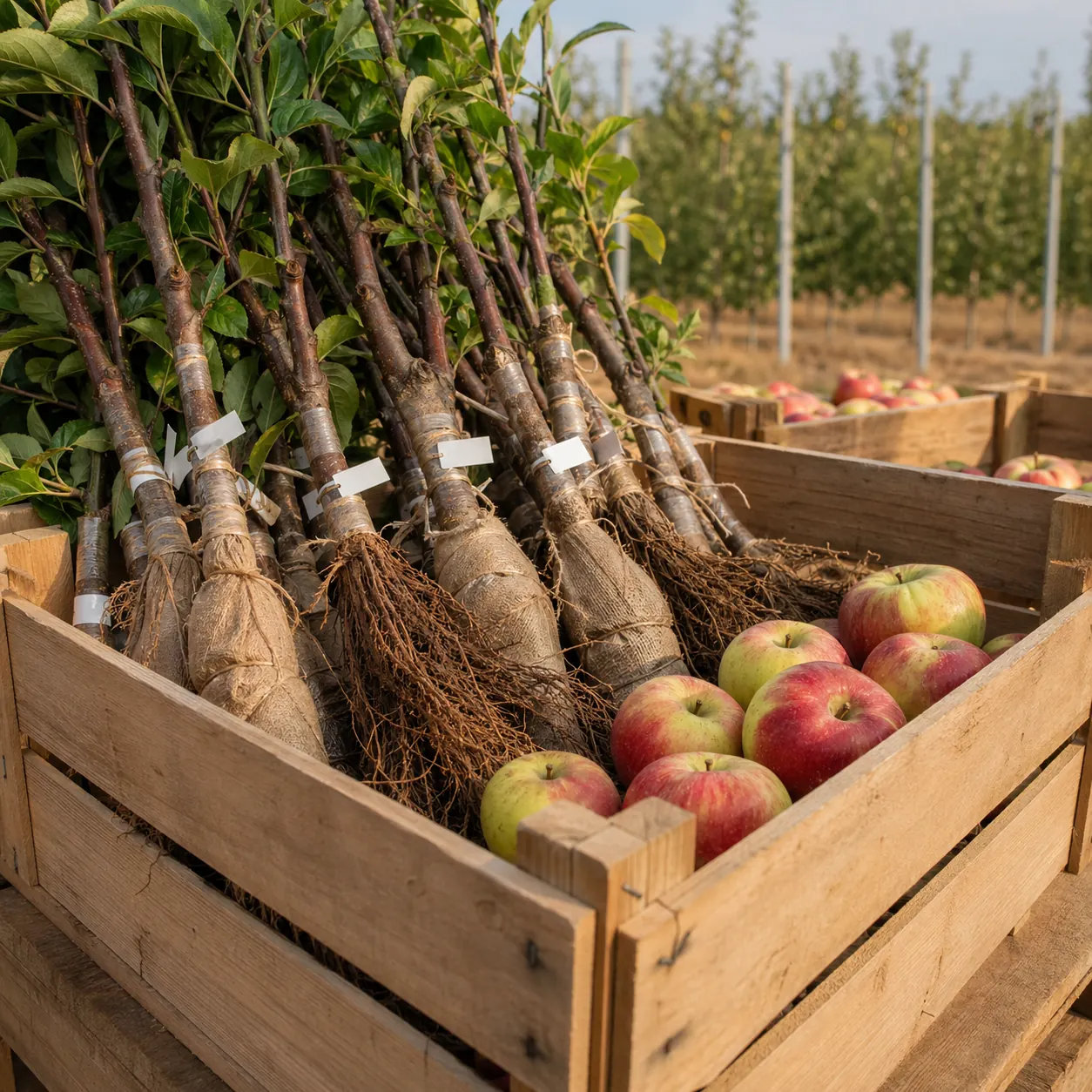
When a farm plants a commercial orchard, the count runs into thousands of saplings, and the cost of a mistake is high: a cultivar mix-up, weak planting stock or an unknown rootstock only show up two or three seasons later, when it is too late to change anything. That is why professional buyers prefer to work directly with the nursery rather than through a reseller. Below is how a wholesale sapling purchase from the grower works, step by step, and what to watch at each stage.
What "buying saplings wholesale" means with us
We work wholesale only — the nursery does not ship one or two trees at retail. The minimum lot is 6,000 saplings per order, and it does not have to be a single cultivar: a lot can be assembled from several crops and cultivars to fit your orchard plan. This is the logic any commercial farm thinks in: you plant a block or several blocks at once, not individual trees.
Indicative wholesale prices — the basis for pricing a lot:
- Apple (knip trees) — 360 ₽ for grade 1+, 400 ₽ for 3+, 450 ₽ for 5+.
- Sweet cherry — 800 ₽ per sapling.
- Pear Xenia — price and availability on request.
The exact price depends on the crop, cultivar, rootstock and volume, so the total is always calculated for a specific order. The easiest way to check current positions and availability is the live sapling catalogue — the table updates as the season ships.
Why direct from the nursery beats a reseller
A reseller or broker is an extra link between the orchard and whoever actually grew the tree. Our principle is simple: no broker markups and no mystery rootstock. What that means in practice:
- Price without a middleman markup — you pay the grower, not for a resale.
- Traceable rootstock and origin — we know what each cultivar is grafted on and where the material comes from.
- Phytosanitary documents for the lot itself, not "for the nursery in general".
- Hand sorting with no cultivar mix-up — what you ordered is what ships, crop and cultivar match.
- Direct contact with an agronomist — you can discuss rootstock, scheme and substitutions before shipping, not through a chain of managers.
| What we compare | Direct from the nursery | Through a reseller |
|---|---|---|
| Price / markup | Grower price, no middleman markup | Reseller margin on top of the nursery price |
| Rootstock traceability | Rootstock and origin of each lot are known | Often "rootstock unknown", mixed material |
| Documents | Phytosanitary documents for the specific lot | Generic documents or none |
| Cultivar control / mix-up | Hand sorting, cultivar confirmed | Risk of a mix-up during transfer and re-sorting |
| Minimum lot | From 6,000 units, can mix cultivars | Any volume, but no quality guarantees |
The ordering process: six steps
To keep the purchase free of surprises, we run it on a clear scheme. Six steps from the first thought to trees at your yard:
- Size your need. Fix the crops, cultivars, rootstock, quantity per position and the desired planting window (spring or autumn). This is the basis of the whole quote.
- Request the current stock list and a quote. We send the current positions and prices and price the lot against your list.
- Confirm availability on the live catalogue table. Check positions against the sapling catalogue — availability there reflects the real remaining stock of the season.
- Book the lot and get an invoice. We reserve the required quantity for you and issue an invoice for payment.
- Agree a self-pickup date. We set a convenient shipping window at the sorting yard near Stavropol.
- Acceptance with paperwork at the yard. At pickup you accept the lot, check the sorting and receive the documents in hand.
Need the current stock list and a lot quote?
Send your list of crops, cultivars and quantities — we will prepare current prices, check availability and price a lot from 6,000 units.
Payment, shipping and self-pickup
Shipping runs in two windows — spring and autumn 2026. These are the natural timings for planting stock: a sapling must go into the ground while dormant, so lots are issued specifically for spring or autumn planting. On which window to choose for your region and crop, we wrote in detail in planting saplings in spring or autumn.
The base way to receive a lot is self-pickup from the sorting yard near Stavropol (Sunzha village). The lot is assembled and sorted by the agreed date so you collect ready, counted planting stock. Payment under the fall 2026 / spring 2027 price list: 30% on signing the contract, the balance 10 days before pickup.
Exactly how we assemble, sort and hand over a lot at the yard is shown step by step on the how we sort and hand over a lot page. It clears up most acceptance questions before you even arrive.
Custom grafting: when the cultivar you need is not in stock
If the cultivar or rootstock you need is not in the current stock, it can be ordered for grafting. The logic here is different and the lead time is longer: such an order takes a 30% deposit and the lead time is about two seasons, because the tree has to be physically grafted and grown to a marketable size. It is a workable option for a planned planting, when you know the cultivar mix in advance and are not chasing the nearest window.
Checklist: what to prepare for the request
The more precise the request, the faster and more realistic the quote. Before you reach out, prepare four things:
It is also worth working out in advance which documents for planting stock to check at acceptance — this protects against a cultivar mix-up and phytosanitary problems. We gathered it in a separate article: which documents to check when buying saplings.
Once your list is ready, the rest is simple: check positions against the live catalogue and submit a request — we will come back with the current stock list, a quote and shipping dates.
The essentials, in brief.
What is the minimum wholesale lot of saplings?
The minimum order is 6,000 saplings. The nursery does not ship one or two trees at retail: we work wholesale only, for planting commercial orchards.Can a lot be assembled from different cultivars?
Yes. The minimum of 6,000 saplings does not have to be a single cultivar — a lot can be assembled from several crops and cultivars to fit your orchard plan. The final quote is calculated by the positions on your list.Is there delivery, or self-pickup only?
The base format is self-pickup from the sorting yard near Stavropol (Sunzha village). The lot is prepared and sorted by the agreed date so you collect ready planting stock.What are the shipping timings?
Shipping runs in two windows — spring and autumn 2026. Saplings are issued for spring or autumn planting because the tree must go into the ground while dormant.Why is buying direct from the nursery better than from a reseller?
Direct, you pay the grower price with no middleman markup, get a traceable rootstock and origin, phytosanitary documents for the lot itself, and hand sorting with no cultivar mix-up. Plus you can discuss the rootstock and substitutions directly with an agronomist before shipping.Can I order a cultivar that is not in stock?
Yes, for grafting. Such an order takes a 30% deposit and a lead time of about two seasons: the tree has to be grafted and grown to a marketable size. It is an option for a planned planting with a cultivar mix known in advance.How is a sapling order paid?
Under the fall 2026 / spring 2027 price list — 30% on signing the contract and the balance 10 days before pickup. Terms for large lots are discussed with the trade desk.
Related material
- 01Documents for saplings: what to check when buying a lotA lot of saplings without documents is a blind purchase: the cultivar, rootstock and health status are all unknown. We cover which papers to request from the seller and what each one proves.Read article
- 02How many saplings you need per hectare: intensive orchard planting schemesThe number of saplings per hectare is set by the planting scheme, and the scheme is set by the rootstock. We cover the formula, give a density table and show how much to order in reserve.Read article
- 03When to plant fruit saplings: spring or autumnAutumn or spring is the perennial question of starting an orchard. We cover how autumn and spring planting of bare-root saplings differ, the risks of each window, and what to choose in southern Russia.Read article
Need saplings for your project?
We will match cultivars and rootstocks to your orchard scheme, price a lot from 6,000 units, and set a pickup window — fall 2026 or spring 2027.