How many saplings you need per hectare: intensive orchard planting schemes
How many saplings to order per hectare comes down to one formula and one table. We work through the math on examples and give ready figures for common schemes.
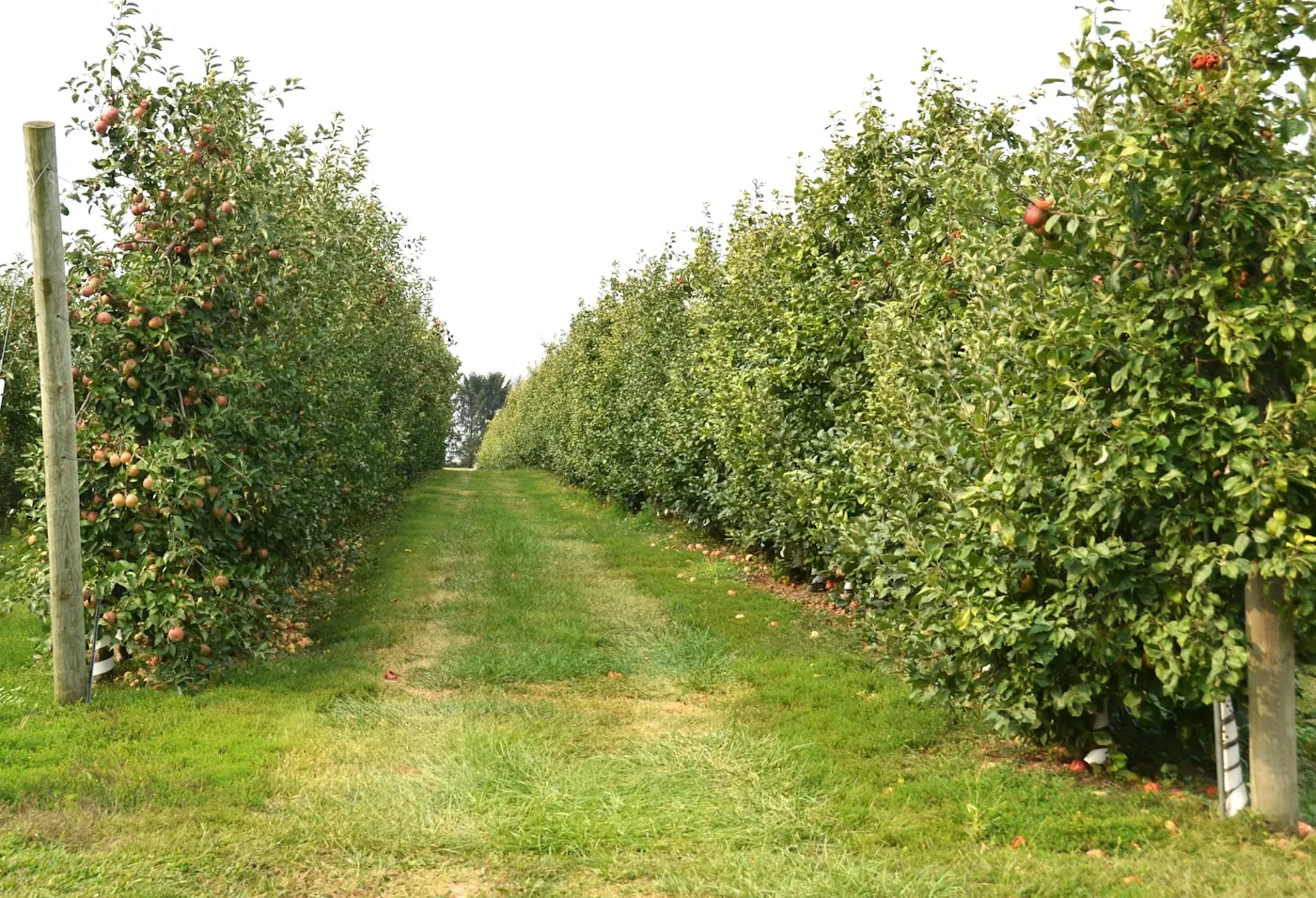
Before planting an orchard, a buyer runs into a simple but important question: how many saplings to order per hectare? An error either way costs money — order too few and gaps remain in the rows; order too many and the surplus trees have nowhere to go. The good news is that the exact count comes from a single formula based on the planting scheme. Let us work through it step by step, give a ready density table and show what reserve to allow.
The formula for saplings per hectare
A hectare is 10,000 m². To find how many trees fit on it, divide that area by the area one tree occupies. And the area per tree is the product of two numbers from the planting scheme: the distance between rows (the row spacing) and the distance between trees within the row (the in-row spacing).
Take a typical intensive scheme of 3.5 × 1.0 m. Area per tree: 3.5 × 1.0 = 3.5 m². Divide the hectare by that area: 10,000 ÷ 3.5 ≈ 2,857 trees per hectare. That is all — nothing else needs calculating; the rest are variations of the same arithmetic with different numbers.
The logic is simple: the denser the scheme (smaller row and in-row spacing), the more trees per hectare and the higher the demand for saplings. So the first step is to settle on a scheme, and the scheme is dictated by the rootstock.
The rootstock sets the density
The planting scheme cannot be chosen at will: it is determined by the vigour of the rootstock. A dwarf tree can be planted densely because it is compact; a vigorous one needs room, otherwise the canopies close up and shade one another. So the sapling calculation always starts with the rootstock.
For an intensive apple orchard the standard is the dwarfing M9 rootstock. Its typical schemes are 3.0–3.5 m between rows × 0.8–1.2 m in the row, which gives roughly 2,500–4,000 trees per hectare. Semi-dwarfing (MM-106) and vigorous rootstocks are planted more sparsely — one and a half to two times fewer trees per hectare, but they are less demanding of care.
Stone fruit has a lower density. Cherry, even on the low-vigour Gisela 5/6 rootstock, grows more spreading than apple, so it is given more room: 4.0–4.5 m between rows × 2.0–2.5 m in the row. That is roughly 890–1,250 trees per hectare — three to four times fewer than an intensive apple orchard.
A density table by scheme
To avoid calculating by hand, here is a ready table for the most common intensive apple orchard schemes. The area per tree is the product of the scheme sides, and trees per hectare is 10,000 divided by that area:
| Scheme (m) | Area per tree | Trees per hectare |
|---|---|---|
| 3.5 × 1.2 | 4.2 m² | ~2,381 |
| 3.5 × 1.0 | 3.5 m² | ~2,857 |
| 3.5 × 0.8 | 2.8 m² | ~3,571 |
| 3.0 × 1.0 | 3.0 m² | ~3,333 |
| 3.0 × 0.9 | 2.7 m² | ~3,704 |
| 4.0 × 1.2 | 4.8 m² | ~2,083 |
You can see how strongly the figure depends on the scheme: at the same 3.5 m row spacing, moving from a 1.2 m step to a 0.8 m step lifts the density from ~2,381 to ~3,571 trees — that is, the demand for saplings grows by half. So the scheme is worth fixing before ordering a lot.
We will calculate the sapling count for your scheme
Send the plot area and the planting scheme — we will return the exact tree count with reserve and price a lot from 6,000 units.
Sapling reserve and usable area
The bare formula gives an ideal number for an ideal rectangle. In practice the calculation gets two corrections — one up, one down.
The first correction is a reserve for replacements. Some saplings do not take, some die in the first year from damping-off, rodents or mechanical damage. To avoid filling gaps with scattered leftovers from the next lot, a small reserve is added to the calculated count — usually 3–5%. For an orchard of 2,857 trees that is roughly 90–140 extra saplings.
The second correction is the usable area. The orchard edges need headlands for machinery, and they fall out of the planting. On a large block that is little, but on narrow or awkwardly shaped plots the actually working area can be 5–10% smaller than the geometric hectare. So for an exact order you count not the "paper" hectare but the area actually being planted.
- Set the planting scheme based on the rootstock (for intensive on M9, usually 3.0–3.5 × 0.8–1.2 m).
- Calculate trees per hectare by the formula: 10,000 ÷ (row spacing × in-row spacing).
- Multiply by the area actually being planted, subtracting the headlands.
- Add a 3–5% reserve for replacements and round up.
From the calculation to ordering a lot
Once the count is calculated, it remains to place the order. The minimum lot at our nursery is 6,000 units: that is one full-size block, enough for roughly 1.5–2.5 ha of intensive apple orchard depending on the scheme. For such a volume we lock in the cultivars, rootstock and shipment dates in advance.
Specific cultivars on M9 are easy to pick from the apple sapling catalogue, and if you want the quantity and cultivar mix calculated for your scheme and area, just leave a request — we will return a ready calculation with reserve and a lot price. How wholesale buying from a nursery works we covered in detail in a separate article on how to buy saplings wholesale.
The essentials, in brief.
How do you calculate the number of saplings per hectare?
Divide 10,000 m² (the area of a hectare) by the area one tree occupies. The area per tree is the row spacing in metres multiplied by the in-row spacing in metres. For example, for a 3.5 × 1.0 m scheme: 3.5 × 1.0 = 3.5 m², and 10,000 ÷ 3.5 ≈ 2,857 trees per hectare.How many apple saplings on M9 per hectare?
For the dwarfing M9 rootstock, typical schemes are 3.0–3.5 m between rows × 0.8–1.2 m in the row, which gives roughly 2,500–4,000 trees per hectare. The exact number depends on the chosen scheme: the denser the planting, the more trees and the higher the demand for saplings.Do you need a reserve of saplings?
Yes. Add 3–5% to the calculated count for replacements: some trees do not take or die in the first year, and gaps are easier to fill with saplings from the same lot than to buy scattered leftovers later. You should also account for headlands, which reduce the area actually being planted.How many cherry trees per hectare on Gisela?
Cherry on the low-vigour Gisela 5/6 rootstock is planted more sparsely than apple — usually 4.0–4.5 m between rows × 2.0–2.5 m in the row. That is roughly 890–1,250 trees per hectare, three to four times fewer than in an intensive apple orchard on M9.Why does the same scheme give a different number of trees?
Because the count is sensitive to the in-row spacing. At the same 3.5 m row spacing, moving from a 1.2 m step (~2,381 trees) to a 0.8 m step (~3,571 trees) raises the density by half. So before ordering a lot the scheme should be fixed precisely — down to a tenth of a metre.
Related material
- 01M9 rootstock for apple: traits and when to choose itThe dwarfing M9 rootstock is the backbone of an intensive apple orchard: early fruiting, dense planting, predictable per-tree economics. We cover its traits, schemes and limits.Read article
- 02When to plant fruit saplings: spring or autumnAutumn or spring is the perennial question of starting an orchard. We cover how autumn and spring planting of bare-root saplings differ, the risks of each window, and what to choose in southern Russia.Read article
- 03How to buy saplings wholesale direct from the nurseryA step-by-step guide to ordering saplings wholesale direct from the nursery — from stock list and booking to self-pickup with paperwork — and why a direct supply beats a reseller.Read article
Need saplings for your project?
We will match cultivars and rootstocks to your orchard scheme, price a lot from 6,000 units, and set a pickup window — fall 2026 or spring 2027.