Gisela 5 or Gisela 6: which rootstock to choose for cherry
Gisela 5 and Gisela 6 are the most sought-after clonal cherry rootstocks. We cover how they differ, which is more demanding, and how to choose the rootstock for your soils, cultivars and level of agronomy.
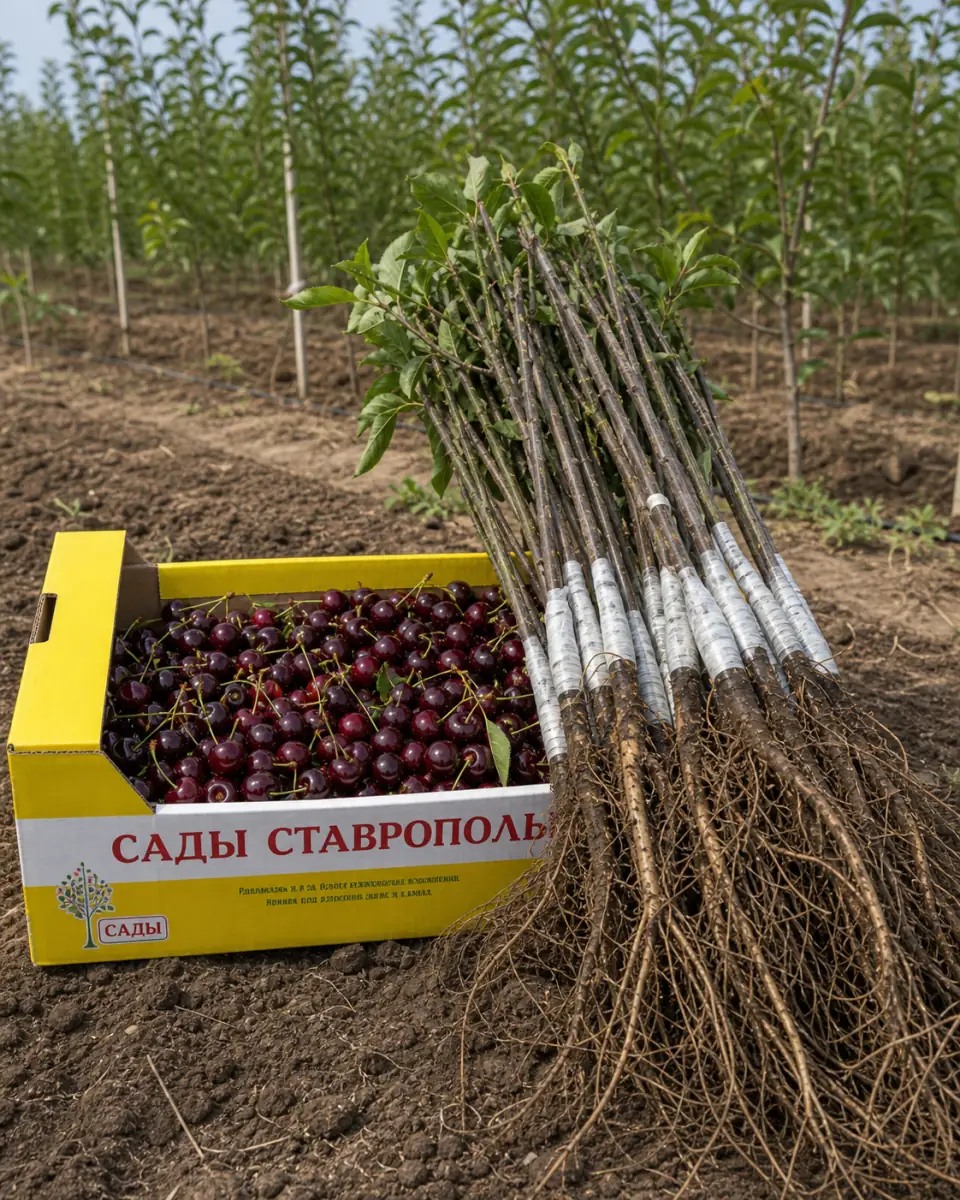
When a buyer picks cherry saplings for a new orchard, the choice almost always comes down to two rootstocks — Gisela 5 and Gisela 6. Both moved cherry out of the "big tree you cannot climb" category into the format of an intensive orchard: a low canopy, an early crop, easy harvest. But there is a fundamental difference between them, and a mistake at this stage is locked into the orchard for 12–15 years ahead. Let us go through how Gisela 5 and Gisela 6 differ and which rootstock to choose for your conditions.
What the Gisela rootstocks are
Gisela is a series of clonal cherry and sour-cherry rootstocks developed at the University of Giessen in Germany. "Clonal" means the rootstock is propagated vegetatively rather than from a stone: every plant is genetically identical, so the orchard grows evenly and predictably. This is the key difference from the old seedling rootstock (wild cherry) and the vigorous Colt rootstock, on which the tree grew to 5–7 metres and only began to fruit properly by its 6th–7th year.
The key thing the Gisela series delivered is early and heavy fruiting on a compact tree. A cherry grafted on Gisela sets flower buds already in the nursery and reaches a marketable crop in the 3rd–4th year. That is exactly why cherry on Gisela has become the standard of intensive orchards across Europe and southern Russia. In this logic, Gisela is to cherry roughly what the M9 rootstock became to apple.
Gisela 5: the maximum dwarf
Gisela 5 (Gi 5) is the more dwarfing of the two rootstocks: vigour is around 45–50% of a seedling. The tree comes out compact (3–3.5 m), enters fruiting very early and gives the highest early crop. This is the rootstock for those building a truly intensive orchard with high planting density.
The price for this is high demand. Gisela 5 only performs on fertile soils, with drip irrigation and a mandatory trellis: the weak root system does not hold the tree under the crop. A separate point is crop-load management. Gisela 5 tends to over-crop itself with set fruit: if you do not ration the crop by pruning and manage the load, the tree stalls and the fruit goes small. So Gisela 5 is best on strong, well-managed sites and with vigorous cultivars that compensate for the dwarfing of the rootstock.
Gisela 6: a semi-dwarf and all-rounder
Gisela 6 (Gi 6) is a semi-dwarfing rootstock, more vigorous: around 60–70% of a seedling. The tree is slightly larger than on Gisela 5 but still compact and convenient for an intensive-type orchard. The main advantage of Gisela 6 is that it is far more tolerant of less-than-ideal conditions.
Gisela 6 copes better with heavier and more variable soils, reacts more calmly to interruptions in agronomy and works well with weaker cultivars for which the vigour of Gisela 5 is no longer enough. It holds fruit calibre more easily and is less prone to over-cropping, so it forgives less strict crop-load management. On balance it is a more general-purpose and forgiving choice — especially when the site or the level of care is not guaranteed to be perfect.
Gisela 5 and Gisela 6: a comparison
If we condense the differences between the two rootstocks into one table, it looks like this:
| Parameter | Gisela 5 | Gisela 6 |
|---|---|---|
| Vigour | Dwarfing, 45–50% of a seedling | Semi-dwarfing, 60–70% of a seedling |
| Tree height | 3–3.5 m | 3.5–4 m |
| Planting density | High, dense intensive | Medium, moderate intensive |
| Start of fruiting | 3rd–4th year | 3rd–4th year |
| Soil demands | High, fertile soils only | More moderate, tolerates heavy and variable |
| Support | Required | Preferred |
| Crop-load management | Critical, prone to over-cropping | Easier, holds calibre better |
| Best cultivars and conditions | Vigorous cultivars, strong sites, high agronomy | Weak cultivars, difficult soils, medium agronomy |
It is important to understand that "weaker" and "stronger" here are not about the quality of the rootstock but about vigour and demand. Both rootstocks give an excellent intensive orchard — the only question is how well your site and agronomy match the requests of Gisela 5. If they match, it repays you with an early and heavy crop. If not, Gisela 6 will be more reliable.
Need a rootstock selection for your orchard?
We will advise which Gisela to take for each cultivar given your soils and planting scheme, and price a lot from 6,000 units.
How to choose between Gisela 5 and Gisela 6
Take Gisela 5 if you have fertile soil, drip irrigation and a trellis, you are ready to ration the crop and you are planting a dense intensive orchard with vigorous cultivars. In these conditions Gisela 5 gives the maximum return per hectare earliest of all.
Take Gisela 6 if the soils are heavy or variable, care is not guaranteed at its maximum, the cultivar mix includes weak cultivars, or you want a more forgiving orchard without strict crop-load management. Gisela 6 is the sensible default when there is no certainty the site will meet the requirements of Gisela 5.
In practice many farms combine the two: vigorous cultivars on Gisela 5, weak and problem blocks on Gisela 6. The cherry sapling catalogue helps you pick the cultivar and rootstock for your scenario, and we covered how the cultivars themselves differ in the article on cherry cultivars.
For fall 2026 and spring 2027 our nursery has sweet cherry on Gisela 5 and Gisela 6 rootstocks in five cultivars — Lapins, Summit, Ferrovia, Samba and Sweet Lorenz — at RUB 800 per unit for a lot from 6,000 units. Samba is on Gisela 6 only. For each cultivar we will advise the optimal rootstock based on your conditions.
The essentials, in brief.
Which is better for weak cultivars — Gisela 5 or Gisela 6?
For weak cultivars Gisela 6 is better: it is more vigorous and compensates for the cultivar lacking vigour of its own, giving a full-sized tree. On Gisela 5 a weak cultivar can turn out too small and under-loaded. Vigorous cultivars, by contrast, are well restrained by Gisela 5.Does Gisela 5 need support?
Yes, support is mandatory on Gisela 5. The root system of the dwarfing rootstock does not hold the tree under the weight of the crop, so growers use a trellis or an individual stake. On Gisela 6 support is preferred, but the requirements are milder thanks to its greater vigour.How does Gisela differ from a seedling rootstock?
A seedling (wild cherry) is a vigorous rootstock: the tree grows to 5–7 m, fruits late and is awkward to care for and harvest. Gisela is a clonal semi-dwarfing or dwarfing rootstock: the tree is compact (3–4 m), enters fruiting in the 3rd–4th year and gives an even, predictable orchard. For an intensive commercial orchard you choose Gisela.In what year does cherry on Gisela start fruiting?
First fruit appears in the 3rd year after planting, and a marketable crop in the 3rd–4th year. That is one and a half to two times faster than on a seedling, and one of the main reasons Gisela is chosen for intensive orchards.Can Gisela 5 and Gisela 6 be combined in one orchard?
Yes, this is a common practice. Vigorous cultivars and strong sites are planted on Gisela 5 for the maximum early crop, while weak cultivars and blocks with more difficult soil go on Gisela 6 for reliability. The main thing is to account for the different vigour when planning the planting scheme.Which rootstock is more demanding of soil and irrigation?
Gisela 5 is more demanding: it only performs on fertile soils with drip irrigation and regular feeding. Gisela 6 is more tolerant of heavy and variable soils and copes more calmly with interruptions in agronomy, although good irrigation and feeding benefit both rootstocks.
Related material
- 01Sweet cherry cultivars for a commercial orchard: Kordia, Regina and pollinizersKordia and Regina are two late commercial sweet cherries that a commercial orchard is built on. We cover their traits and the main trap — both are self-sterile and need a pollinizer.Read article
- 02M9 rootstock for apple: traits and when to choose itThe dwarfing M9 rootstock is the backbone of an intensive apple orchard: early fruiting, dense planting, predictable per-tree economics. We cover its traits, schemes and limits.Read article
- 03When to plant fruit saplings: spring or autumnAutumn or spring is the perennial question of starting an orchard. We cover how autumn and spring planting of bare-root saplings differ, the risks of each window, and what to choose in southern Russia.Read article
Need saplings for your project?
We will match cultivars and rootstocks to your orchard scheme, price a lot from 6,000 units, and set a pickup window — fall 2026 or spring 2027.