M9 rootstock for apple: traits and when to choose it
M9 is the most widely used dwarfing apple rootstock in intensive orcharding. We cover what it gives an orchard, where its limits are, and who it suits.
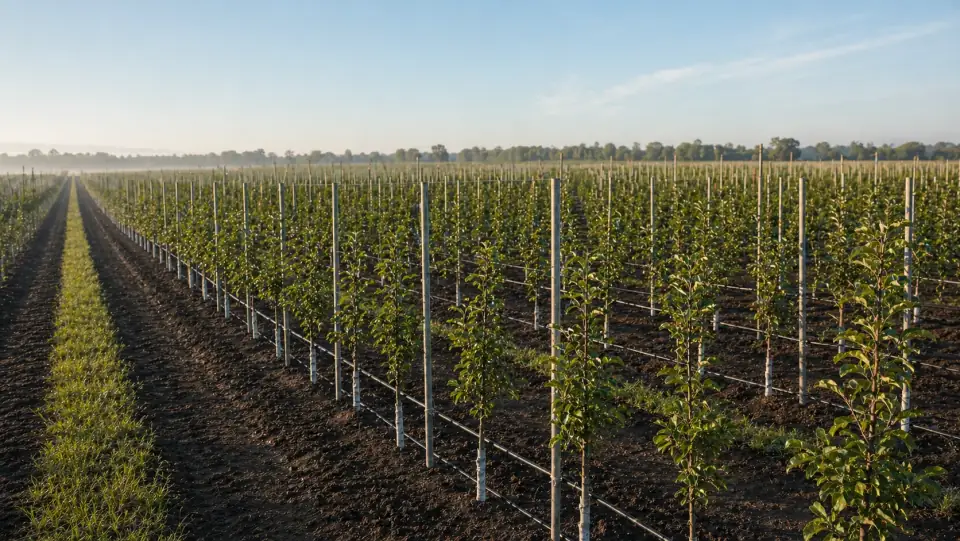
When a buyer picks apple saplings for a new orchard, the first question is usually not about the cultivar but about the rootstock. And the answer is most often M9. This dwarfing rootstock has become the standard of intensive orcharding across Europe and southern Russia: orchards on M9 start yielding a marketable crop in their 2nd–3rd year. Let us go through what M9 is, its traits, and when you should — and should not — choose it.
What the M9 rootstock is
M9 (Malling 9) is a clonal dwarfing apple rootstock developed at the East Malling research station in England in the early 20th century. "Clonal" means the rootstock is propagated vegetatively rather than from seed: every plant is genetically identical, so the whole orchard grows evenly and predictably. A cultivar grafted on M9 grows into a tree about 2–2.5 m tall — that is the "dwarf".
The key thing M9 delivers is control over vigour. The tree does not spend years building wood mass; it switches to fruiting quickly. That is exactly why M9 is the basis of what is called an intensive orchard: dense planting, a trellis, drip irrigation and an early return on investment.
Traits of the M9 rootstock
If we condense the agronomic properties of M9 into a table, it looks like this:
| Parameter | Value |
|---|---|
| Vigour | Dwarfing (25–35% of a seedling rootstock) |
| Tree height | 2–2.5 m |
| Start of fruiting | 2nd–3rd year after planting |
| Planting scheme | 3.0–3.5 m between rows × 0.8–1.2 m in the row |
| Density | 2,500–4,000 trees per hectare |
| Support | Required — trellis or individual stake |
| Irrigation | Drip preferred — the root system is shallow |
| Orchard lifespan | 15–20 years |
M9 has a fibrous, shallow root system. That is both a plus and a minus: the tree is easy to manage and fruits early, but it holds itself poorly in the soil and is sensitive to water shortage. Hence the two mandatory conditions — support and irrigation.
Pros and cons of M9
The strengths M9 is chosen for:
- Early fruiting — a marketable crop in the 2nd–3rd year, faster payback than on vigorous rootstocks.
- High density — far more trees fit per hectare, higher output per area.
- Ease of care — a low canopy is easy to prune, spray and harvest without machinery or ladders.
- Fruit quality — a well-lit canopy gives even colour and calibre, important for the fresh market.
- Predictability — a clonal rootstock grows uniformly, making the orchard easier to plan and ration.
The limits you should budget for up front:
- Mandatory support — without a trellis or stake the tree topples under the crop.
- Dependence on irrigation — shallow roots cannot reach deep moisture; drip irrigation is needed.
- Demand for a good agro-background — M9 only performs with regular feeding and care.
- Higher start-up cost per hectare — more saplings, a trellis, an irrigation system.
Need a quote for saplings on M9?
We will match cultivars and quantity to your planting scheme and price a lot from 6,000 units.
When to choose M9 — and when not to
M9 is the right choice if you are planting a commercial intensive orchard and are ready for its technology: trellis, drip irrigation, regular feeding and pruning. In southern Russia, including Stavropol Krai, such orchards are the main format of commercial apple growing.
M9 is worth reconsidering if: the plot has no irrigation option; you do not plan to install support; the soils are poor and you will not improve them; or you need an extensive "plant and forget" orchard. In those cases, look toward semi-dwarfing rootstocks (MM-106) or vigorous ones — they forgive a lack of care, though they fruit later.
If the intensive technology is your scenario, the next question is density and tree count. We covered it separately in how many saplings you need per hectare, and the apple sapling catalogue helps you pick specific cultivars on M9.
The essentials, in brief.
In what year does an apple tree on M9 start fruiting?
First fruit appears as early as the 2nd year after planting, and a marketable crop in the 3rd–4th year. This is the main reason M9 is chosen for intensive orchards: the investment pays back faster than on vigorous rootstocks.Does an M9 orchard need a trellis?
Yes, support is mandatory. M9 has a shallow fibrous root system, and the tree topples under the weight of the crop. Growers use either a trellis (a row of posts with wire) or an individual stake at each tree.How long does an apple orchard on M9 live?
The productive lifespan of an intensive orchard on M9 is 15–20 years. In that time the orchard pays back several times over, after which it is grubbed out and replanted with an updated cultivar mix.Is M9 suitable for regions with frost?
M9 is moderately winter-hardy, but its root system is less frost-resistant than that of vigorous rootstocks. In southern Russia, including Stavropol Krai, M9 performs well. In colder zones growers use snow retention, mulching of the tree strip and hardy interstems.How does M9 differ from MM-106?
M9 is a dwarfing rootstock (a 2–2.5 m tree, dense planting, early crop, mandatory support). MM-106 is semi-dwarfing: a larger tree that fruits later but is more tolerant of water shortage and does not always require a trellis. For an intensive commercial orchard, choose M9; for simpler care, MM-106.
Related material
- 01How many saplings you need per hectare: intensive orchard planting schemesThe number of saplings per hectare is set by the planting scheme, and the scheme is set by the rootstock. We cover the formula, give a density table and show how much to order in reserve.Read article
- 02How to choose apple cultivars for a commercial orchardThe cultivar decides who buys your crop and when. We cover the criteria for choosing commercial apple cultivars for an intensive M9 orchard: market, timing, marketability, storage and pollination.Read article
- 03How to buy saplings wholesale direct from the nurseryA step-by-step guide to ordering saplings wholesale direct from the nursery — from stock list and booking to self-pickup with paperwork — and why a direct supply beats a reseller.Read article
Need saplings for your project?
We will match cultivars and rootstocks to your orchard scheme, price a lot from 6,000 units, and set a pickup window — fall 2026 or spring 2027.