How to choose apple cultivars for a commercial orchard
The rootstock sets the orchard technology; the cultivar sets its economics: the sales window, the price and the buyer. We cover the criteria for picking commercial apple cultivars for an intensive orchard in southern Russia.
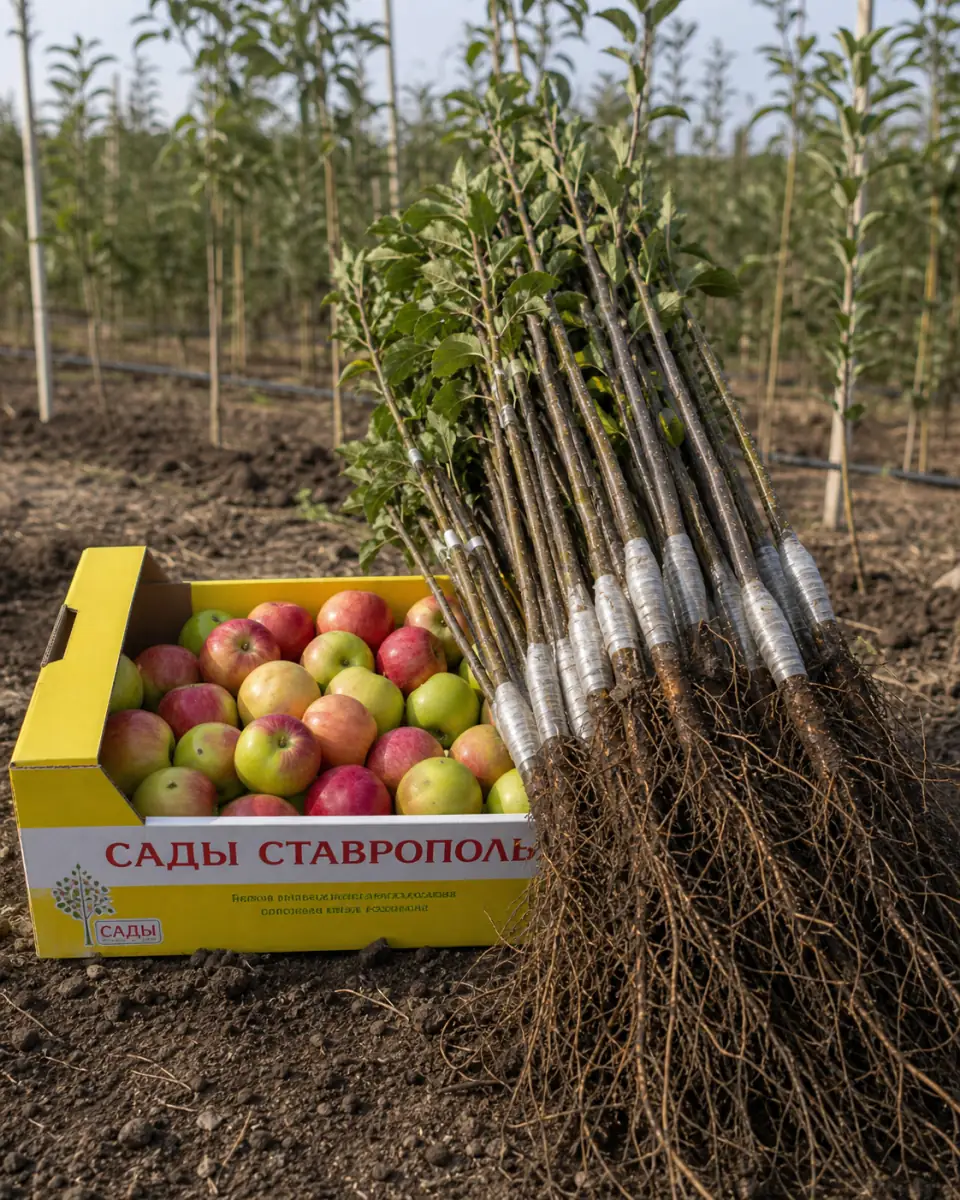
The rootstock decides *how* the orchard grows; the cultivar decides *who buys the crop and when*. These are two separate questions, and the second is no less important. The same orchard on the M9 rootstock can be planted with cultivars that go to the fresh market in August at an average price, or with storage cultivars that keep until spring and sell for twice as much. Let us go through the criteria a buyer uses to pick commercial apple cultivars for a commercial orchard, and which cultivar groups go into a marketable block.
The criteria for choosing a cultivar
A cultivar for a commercial orchard is judged not by its taste off the branch but by how it behaves on the shelf and in the sale. The basic set of criteria looks like this:
- Market demand — which channel the orchard serves: fresh market, long storage or export. This drives the whole cultivar mix.
- Ripening window — early, autumn and late cultivars stretch the harvest and sales out instead of one peak window.
- Color and calibre — fruit marketability: even surface color and consistent size feed directly into the price.
- Storage life — how long a cultivar holds its marketable look in cold store and how late into the year it can be sold.
- Pollination group — apple is self-unfruitful, so you need cross-compatible cultivars or dedicated pollinators.
- Scab resistance and fitness for the south — fewer sprays, a steadier marketable yield in a hot dry summer.
- Fitness for intensive technology — how manageable a cultivar is on M9: bearing habit, tendency to crowd, branching.
These criteria then fold into a simple logic: first you fix the sales channel, then you pick cultivar groups for it with different ripening windows, and only within the groups do you choose specific cultivars with the right color, storage life and pollinators. Let us look at the key criteria in more detail.
Market demand: which channel the orchard serves
This is the first and main question, because it decides everything else. The fresh market wants volume and a recognizable cultivar that sells straight off the truck: this is where the Gala family and red clones work — steady demand, a clear price, large lots. Storage is a long game: storage cultivars go into cold store in autumn and sell in winter and spring, when the price is higher. Export and the premium shelf set the toughest demands on color, calibre and uniformity — that is where premium cultivars with protected names go.
In practice a commercial orchard is almost never built for a single channel. It is wiser to plant volume cultivars for the fresh market, storage cultivars for cold store and a small premium block as well — so the revenue spreads across the season rather than depending on one peak sales window.
Ripening window and a stretched harvest
If the whole orchard ripens in one week, you run into a shortage of labor at harvest, a queue at grading and a price crash when everyone sells the same thing at once. So a marketable cultivar mix is assembled to stretch the harvest out: early and autumn cultivars (the Gala family) are picked sooner, storage ones (Fuji, Granny Smith) later. That removes the peak load and gives several sales windows at different prices.
The main cultivar groups in a commercial orchard
To keep the cultivar mix balanced across channels and ripening windows, it is convenient to assemble it from four working groups. For fall 2026 and spring 2027 our nursery offers 17 commercial apple cultivars on M9, and they cover all four:
| Segment | Example cultivars | Purpose |
|---|---|---|
| Gala family | Gala Royal, Gala Devil, Gala Schniga Red | Fresh-market volume |
| Red cultivars | Red Delicious Mema, Red King Roat, Williams' Pride | Bright, stable color |
| Storage cultivars | Granny Smith, Golden Delicious Rangers, Fuji | Storage and late sales |
| Premium tier | Modi, Inored Story, Pink Lady, Ambrosia, Jeromine, Crimson Crisp | Premium shelf and export |
The Gala family is the workhorse of the fresh market: an even two-tone color, good transportability, recognition with the buyer. Red clones (based on Red Delicious and Jonagold) are chosen for the deep surface color that holds the price on the shelf. Storage cultivars — Granny Smith, Fuji, Honey Crisp, Golden Delicious Rangers — go in for long storage: they sell when early cultivars are no longer on the market. The premium tier (Modi, Pink Lady, Inored Story, Crimson Crisp, Jeromine) is protected cultivars for the premium shelf and export, with the highest demands on marketability.
Need the current apple cultivar list?
We will send current stock for all 17 cultivars with the price per sapling and help you assemble a mix for your sales channel and planting scheme.
Pollination groups: why one cultivar is not enough
Apple is largely self-unfruitful: a flower does not set a full fruit from its own pollen. For the orchard to pollinate properly and yield a marketable crop, it needs cross pollen from another cultivar. So a block is planted with 2–3 cross-compatible cultivars whose bloom overlaps — they pollinate each other — or dedicated pollinator cultivars are added that bloom heavily and long and cover pollination for the whole block.
Two rules to follow when selecting: the cultivars must bloom at the same time (otherwise the pollen of one will not reach the flowers of another) and be compatible for pollination. In our catalogue the pollinators are listed separately (Viola, Golden Hornet, Professor Springer, Red Sentinel, Sansa) and marked in the live table — which removes the question of what to pollinate your chosen cultivar with. It is best to pick the specific pairs together with an agronomist or the nursery trade desk: what matters is not theory but the practical compatibility of cultivars that are actually in stock.
Scab resistance and fitness for intensive technology
In southern Russia the summer is hot and dry, but in wet spells scab remains the main threat to the marketable look of the fruit. Cultivars with raised scab resistance (for example Inored Story, Crimson Crisp) need fewer sprays and give a steadier marketable yield — a direct saving on crop protection and confidence in clean fruit.
Fitness for intensive technology is how manageable a cultivar is on the M9 rootstock: its bearing habit, its tendency to crowd the canopy, the ease of training it on a trellis. A well-behaved cultivar sets fruiting wood evenly, does not run into crowding and responds predictably to pruning — which makes the orchard easier to ration and harvest. Once the cultivar mix is set, the remaining step is to work out the tree count: we covered that in how many saplings you need per hectare.
How to assemble the cultivar mix in practice
Let us put it all into a working order of steps — this is how a cultivar mix is assembled for planting a commercial block:
- Fix the sales channel: fresh market, storage, export or a combination.
- Pick 3–5 cultivars from different groups with different ripening windows to stretch out the harvest and sales.
- Cover pollination: add cross-compatible cultivars or pollinators whose bloom overlaps.
- Set a share of storage cultivars for cold store if you have one and plan on winter sales.
- Check against the agro-background and scab resistance for the conditions of your plot.
- Request current stock and assemble the lot from the apple sapling catalogue on M9.
A finished cultivar mix is almost always a compromise between what you want and what is actually in stock for the season. So it is worth starting from the live apple sapling catalogue on M9: it shows current stock per cultivar, the price per sapling and pollinator notes. The nursery trade desk will help you assemble a lot from 6,000 units for your sales channel, planting scheme and ripening schedule.
The essentials, in brief.
Which apple cultivars are best for southern Russia?
For southern Russia you choose commercial cultivars that tolerate heat and scab and color up well in a dry summer. For the fresh market — the Gala family and red clones; for storage — Granny Smith, Fuji, Honey Crisp, Golden Delicious Rangers; for the premium tier — Modi, Pink Lady, Inored Story, Crimson Crisp. All of them are grafted on the M9 rootstock for an intensive orchard.How many cultivars do you need for pollination?
Apple is self-unfruitful, so one cultivar is not enough. A block is planted with at least 2–3 cross-compatible cultivars whose bloom overlaps, or dedicated pollinators are added (Viola, Golden Hornet, Professor Springer, Red Sentinel, Sansa). The key condition is that the cultivars bloom at the same time and are compatible for pollination.Which apple cultivars store the longest?
The storage cultivars are Granny Smith, Fuji, Honey Crisp and Golden Delicious Rangers — they hold their marketable look in cold store and sell in winter and spring, when early cultivars are off the market and the price is higher. This is the base set for an orchard built around long storage.Which cultivars suit an intensive orchard on M9?
An intensive orchard suits well-behaved cultivars that grow manageably on the dwarfing M9 rootstock and come into bearing early. At our nursery all 17 commercial apple cultivars are grafted on M9 — from the high-volume Gala family to premium Pink Lady and Modi — so any cultivar mix can be assembled for intensive technology.How many apple cultivars should you plant in one orchard?
A commercial block usually takes 3–5 cultivars from different groups with different ripening windows. That stretches the harvest out, removes the peak load on labor and cold store, covers pollination and gives several sales windows at different prices. A single-cultivar monoblock is a risk both for pollination and for sales.How do fresh-market and storage cultivars differ?
Fresh-market cultivars (the Gala family, red clones) bet on volume, recognition and selling straight off the truck right after harvest. Storage cultivars (Granny Smith, Fuji, Honey Crisp) are picked later and go into cold store to sell in winter and spring at a higher price. A balanced orchard plants both.
Related material
- 01M9 rootstock for apple: traits and when to choose itThe dwarfing M9 rootstock is the backbone of an intensive apple orchard: early fruiting, dense planting, predictable per-tree economics. We cover its traits, schemes and limits.Read article
- 02How many saplings you need per hectare: intensive orchard planting schemesThe number of saplings per hectare is set by the planting scheme, and the scheme is set by the rootstock. We cover the formula, give a density table and show how much to order in reserve.Read article
- 03Sweet cherry cultivars for a commercial orchard: Kordia, Regina and pollinizersKordia and Regina are two late commercial sweet cherries that a commercial orchard is built on. We cover their traits and the main trap — both are self-sterile and need a pollinizer.Read article
Need saplings for your project?
We will match cultivars and rootstocks to your orchard scheme, price a lot from 6,000 units, and set a pickup window — fall 2026 or spring 2027.