Sweet cherry cultivars for a commercial orchard: Kordia, Regina and pollinizers
Kordia and Regina are the base cultivars of a commercial cherry orchard. But both are self-sterile: without the right pollinizer there is no fruit set. We cover cultivars, timing and the pollination scheme.
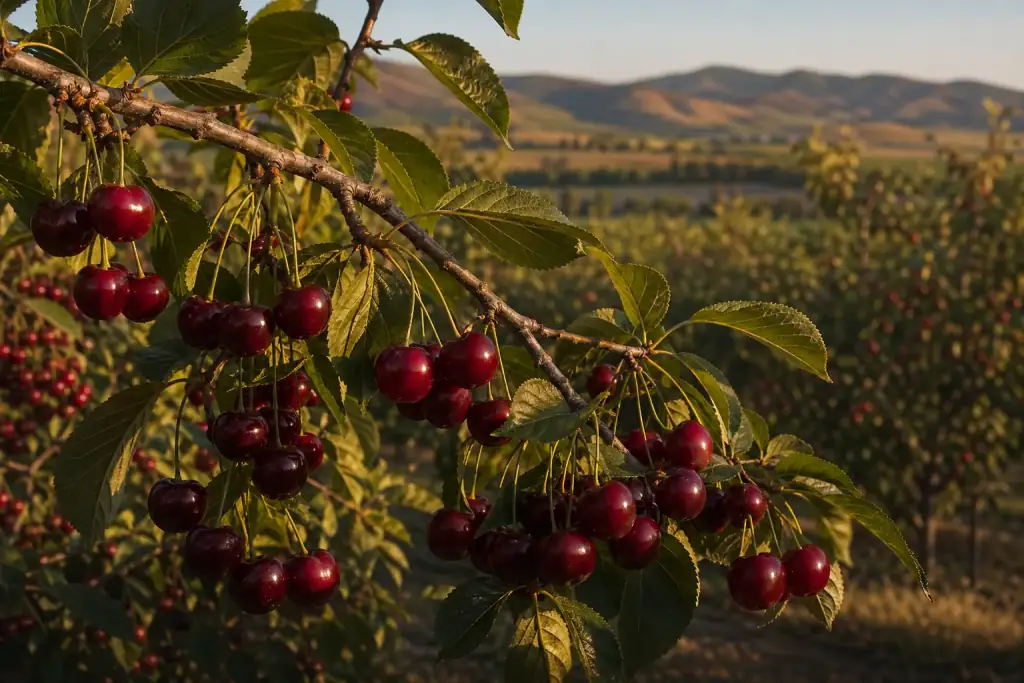
When a commercial sweet cherry orchard is planted, the conversation almost always starts with two cultivars — Kordia and Regina. These are late, large-fruited cherries with firm flesh and excellent shelf life, exactly what wholesale and long-distance logistics need. But this same pair is also where newcomers make their main mistake: both cultivars are self-sterile, and planted together without a third pollinizer cultivar they will give an empty orchard. Let us go through what these cultivars are, how they differ and how to get pollination right.
At the Sady Stavropolya nursery, sweet cherry is supplied grafted on the semi-dwarfing Gisela 5 and Gisela 6 rootstocks — the standard for an intensive orchard. For fall 2026 and spring 2027 five cultivars are in stock — Lapins, Summit, Ferrovia, Samba and Sweet Lorenz; Kordia and Regina are not on the current price list. Below is how to assemble a working cultivar combination.
Kordia sweet cherry: cultivar description
Kordia is a late Czech cultivar, one of the most sought-after in commercial orcharding across Europe. The fruit is dark red, almost maroon, heart-shaped, with firm crisp flesh and a rich sweet flavour. Kordia main asset for wholesale is that it travels and stores well: the firm fruit does not bruise and reaches the shelf in marketable condition.
There is exactly one drawback, but an important one: Kordia is self-sterile. It does not pollinate itself, and in a pure planting without a pollinizer cultivar the fruit set will be negligible. Kordia flowers late, so it also needs a late-flowering pollinizer — more on that in the pollination section below.
Regina sweet cherry: cultivar description
Regina is a German cultivar of a very late ripening time that closes the cherry season. The fruit is large, dark red, with very firm flesh. Two qualities make Regina a benchmark for commerce: exceptional shelf life and high resistance to cracking — Regina handles rain during ripening far more calmly than most cultivars, which is critical for southern orchards.
Like Kordia, Regina is self-sterile and flowers late. The Kordia + Regina pair itself is close in flowering time, and they are often planted side by side as a late commercial tandem — but they should not be treated as each other pollinizer. For reliable fruit set the scheme must include a self-fertile universal pollinizer. Which one exactly — we cover next.
Pollinizers for sweet cherry: how it works
Most sweet cherry cultivars are self-sterile: their own pollen does not set fruit. To get a crop, another pollinizer cultivar must grow nearby, and there are two mandatory conditions here:
- Overlapping flowering — the pollinizer must flower at the same time as the main cultivar, otherwise the pollen simply never meets the blossom. Late cultivars (Kordia, Regina) need a late-flowering pollinizer.
- Pollen transfer — sweet cherry is pollinated by bees, so during flowering the orchard needs active bee work (your own or brought-in hives), and the weather warm enough for them to fly.
The practical solution for a commercial orchard is not to guess pair compatibility by hand but to build in insurance: plant a self-fertile universal pollinizer and/or place 2–3 cultivars with overlapping flowering so that every row has a pollinizer within a bee flight. Then the orchard is pollinated reliably whatever the combination.
Lapins — the universal pollinizer
Lapins is the key cultivar in any cherry orchard scheme. It is self-fertile: it sets fruit with its own pollen and needs no pollinizer itself. Even more important, Lapins serves as a universal pollinizer for other cultivars — its pollen sets neighbouring trees well. The cultivar itself is mid-late, large-fruited and marketable, so it is not a "technical" pollinizer but a full commercial cultivar.
That is exactly why Lapins is the safest companion for Kordia and Regina. It overlaps their late flowering, insures pollination across the whole block and yields a crop of its own. In practice, for every few rows of the main cultivar a row (or scattered trees) of Lapins is added — and the pollination question is closed.
Need the current cherry stock list?
We will send the current price list for sweet cherry saplings on Gisela 5/6 and help build a scheme with pollinizers for your area.
Sweet cherry cultivars and their pollination: a table
Let us condense the key commercial cultivars from the sweet cherry sapling catalogue on Gisela 5/6 into one table — by ripening time and role in pollination:
| Cultivar | Ripening time | Features | Pollination |
|---|---|---|---|
| Kordia | Late | Dark red, firm, excellent transportability | Needs a pollinizer |
| Regina | Very late | Large, very firm, resistant to cracking | Needs a pollinizer |
| Lapins | Mid-late | Large, marketable; self-fertile cultivar | Self-fertile, pollinizer for others |
| Ferrovia | Mid-season | Large-fruited, marketable, extends the conveyor | Needs a pollinizer |
| Summit | Mid-season | Large heart-shaped, good flavour | Needs a pollinizer |
The ripening conveyor: Samba, Sweet Lorenz, Ferrovia
A commercial orchard benefits from not harvesting the whole crop in one week but stretching picking and sales over a month to six weeks. For that, earlier cultivars are added to the late Kordia + Regina pair:
- Sweet Lorenz and Samba — early-mid, large-fruited cultivars; they open the season and give the first marketable wave.
- Ferrovia — a large-fruited mid-season cultivar that holds the middle of the conveyor.
- Summit — a large heart-shaped mid-season cherry of good flavour.
- Kordia and Regina — the late and very late wave; they close the season with the firmest, most transportable fruit.
A further benefit of this set: cultivars with overlapping flowering help pollinate their neighbours, and Lapins among them works as a universal pollinizer for the whole block. The result is an orchard that both pollinates reliably and fruits in waves from early to very late.
How to assemble cultivars into a working orchard
If we reduce it all to a practical scheme, a working commercial cherry orchard looks like this:
- Set the commercial base — for late, long-keeping fruit that is Kordia and Regina; for the conveyor add Ferrovia, Summit, Samba or Sweet Lorenz.
- Build in a pollinizer — always include self-fertile Lapins as a universal pollinizer and plant its trees across the whole orchard, not along one edge.
- Match flowering times — make sure every cultivar has a neighbour with overlapping flowering within a bee flight.
- Provide bees — during flowering the orchard needs active bee work and weather warm enough for them to fly.
The sweet cherry sapling catalogue on Gisela 5/6 helps you pick specific cultivars and quantities for this scheme. If you are also planning an apple orchard, see the breakdown of apple cultivars for a commercial orchard, and for choosing a cherry rootstock, the article Gisela 5 or Gisela 6.
The essentials, in brief.
Does sweet cherry need a pollinizer?
Most cultivars — yes. Self-sterile cultivars (Kordia, Regina, Ferrovia, Summit) do not pollinate themselves, and without a pollinizer cultivar of overlapping flowering time the fruit set will be negligible. The exception is self-fertile cultivars such as Lapins, which fruit without a partner. For a reliable crop the orchard needs active bee work in any case.Which pollinizer suits Kordia and Regina?
Kordia and Regina are both self-sterile and flower late, so they need a late-flowering pollinizer. The most reliable and universal choice is the self-fertile cultivar Lapins: it overlaps their flowering and sets neighbouring trees well. Planting Kordia and Regina only as a pair, expecting them to pollinate each other, is not advisable — add a separate pollinizer to them.How does Regina differ from Kordia?
Both cultivars are late, dark red and firm, but Regina ripens even later than Kordia and is noticeably more resistant to rain cracking, and it also keeps better. Kordia is slightly earlier and prized for its rich flavour and excellent transportability. In practice they are often planted together as a late commercial tandem — but both are self-sterile and require a separate pollinizer.Which sweet cherry is self-fertile?
Among the cultivars in stock, Lapins is self-fertile — it sets fruit with its own pollen and needs no pollinizer. Moreover, Lapins serves as a universal pollinizer for other cultivars, so it is included in almost any cherry orchard scheme. Ferrovia, Summit and Samba are self-sterile and require a pollinizer, as do Kordia and Regina.When does Kordia sweet cherry ripen?
Kordia is a late-ripening cultivar: it ripens toward the end of the cherry season, later than most early and mid-season cultivars. Only the very late Regina ripens later still. It is this late timing, together with the firm, transportable fruit, that makes Kordia convenient for wholesale and long-distance logistics.How many pollinizers does a cherry orchard need?
There is no rigid norm, but a practical guideline for a commercial orchard is for every cultivar to have a pollinizer with overlapping flowering within a bee flight. Usually this is done by adding self-fertile Lapins and placing its trees across the whole orchard rather than in a single edge row, and keeping 2–3 cultivars with close flowering times in the orchard.
Related material
- 01Gisela 5 or Gisela 6: which rootstock to choose for cherryGisela 5 and Gisela 6 are the two clonal rootstocks an intensive cherry orchard is built on. We cover the differences in vigour, demands and fruiting and help you choose for your conditions.Read article
- 02How to choose apple cultivars for a commercial orchardThe cultivar decides who buys your crop and when. We cover the criteria for choosing commercial apple cultivars for an intensive M9 orchard: market, timing, marketability, storage and pollination.Read article
- 03How to buy saplings wholesale direct from the nurseryA step-by-step guide to ordering saplings wholesale direct from the nursery — from stock list and booking to self-pickup with paperwork — and why a direct supply beats a reseller.Read article
Need saplings for your project?
We will match cultivars and rootstocks to your orchard scheme, price a lot from 6,000 units, and set a pickup window — fall 2026 or spring 2027.