Hail nets for an orchard: when you need them and how they are installed
A net shields the rows from hail as a physical barrier but costs noticeably more than a trellis. This covers system types, attachment, cost benchmarks and what to provide for at planting.
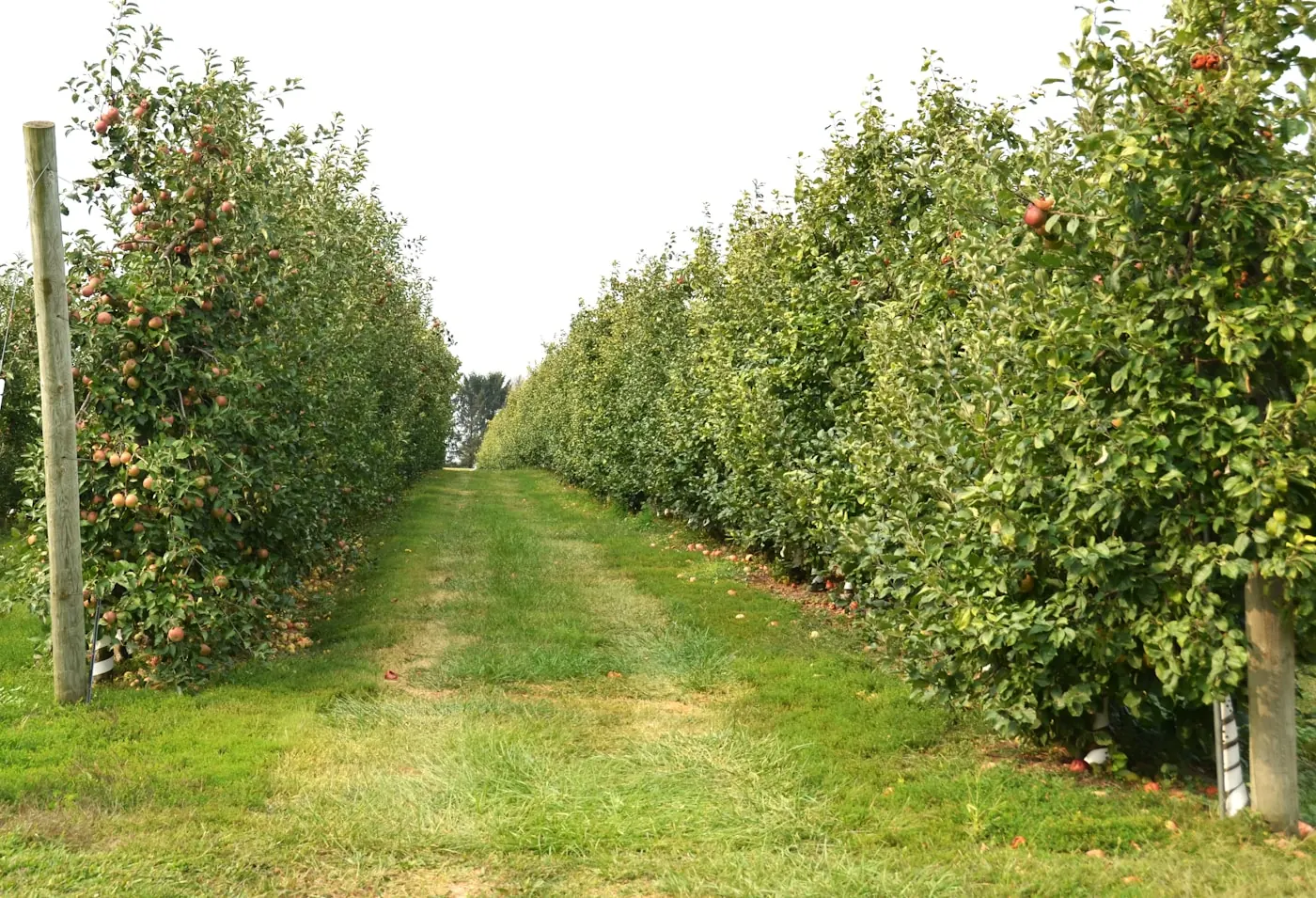
A hail net shields orchard rows from hail physically, and the decision comes before planting, because the height and strength of the trellis posts are sized for the future net. This article covers system types, attachment to the trellis, cost benchmarks from foreign sources and the order of work. A contractor prepares the ruble estimate from the plot design.
Do you need a net: hail risk in the Stavropol region
The decision depends on the plot’s hail exposure and the value of the crop. Of all adverse weather, hail does the most harm to the coming harvest, as the Kursavka portal writes. In 2023 the regional hail-suppression service protected about 839 thousand ha of fields in five districts through 44 impact points. The service works at regional level, while a net stands on a specific plot and covers the rows physically.
The WSU Extension review (TB60E) states that hail damages the current season’s crop and the flower buds of the next one. Young trees suffer more because of their small canopy, and the wounds can worsen disease, above all fire blight. Hail exposure and crop value are weighed before posts are bought, because the post height depends on them.
System types: full enclosure, continuous top net, partial cover
WSU lists three common systems: full enclosure over the top and sides, a continuous net over the orchard, and partial cover over the rows. Partial cover is the cheapest, a continuous net costs more, and full enclosure costs the most.
| System | What it gives | What to weigh |
|---|---|---|
| Full enclosure (top and sides) | full protection from hail and sunburn, partial protection from wind and pests | most expensive, more installation labour, side walls lifted for spraying and access |
| Continuous net over the orchard (over-the-top) | full hail protection, free machinery access, the most common system in Washington State | sides are open, so wind and pest protection is weaker than full enclosure |
| Partial cover over the rows | cheapest system, free machinery access | hail is not fully blocked, rows must run north to south |
| Drape net | simplest installation | still rare in Washington in 2018 |
For a continuous net and full enclosure, WSU notes an important condition: in hail-prone areas the structure needs a configuration that dumps hail onto the ground, otherwise it may collapse. This part of the design goes to a contractor experienced with hail nets.
Net material and attachment to the trellis
The net hangs on cables and posts that are set together with the trellis. The Ontario Apple Growers guide names 16 ft posts (about 4.9 m) for a net over the orchard: up to 4 ft (1.2 m) in the ground and 12 ft (about 3.7 m) above it. In the first years the same posts carry the ordinary trellis wires. Trellis design is in trellis for an intensive apple orchard.
WSU writes that a net is easier to provide for when the orchard is created: the posts serve both as trellis and net support. Of the growers surveyed, 83% planned to include netting when establishing new orchards. Fruit Security Holland gives similar advice: put the supporting structure in at planting and stretch the net 2–3 years later, which saves €1,000–1,500 per hectare.
On weave, the InTechOpen chapter notes that leno netting of monofilament threads is more rigid than the other type and suits strong hail. Nets cut photosynthetically active radiation: up to 7% for translucent, 18% for black and up to 13% for white-green. Fruit colour under some nets can develop later.
A net needs care. Fruit Security Holland advises re-tensioning the system every year and repairing tears at once. In regions with heavy snow WSU recommends opening the net after pollination and furling it after harvest, so snow load does not damage the fabric and supports, and its service life extends by several years.
What a net costs: foreign benchmarks
The ruble price of a net depends on the plot design, so the table gives foreign costs converted per hectare. It is an order-of-magnitude benchmark, not an estimate.
| System | Amount | Source |
|---|---|---|
| Continuous top net, most commonly named amounts | USD 24,700–29,650 (USD 10,000–11,999 per acre) | WSU, 2017 survey |
| Partial cover | USD 9,900–12,350 (USD 4,000–5,000 per acre) | WSU, 2017 survey |
| Drape net | about USD 8,650 (about USD 3,500 per acre) | Fruit Growers News, 2019 |
| Traditional net in the Netherlands | EUR 38,500: materials 23,500 and installation about 15,000 | Fruit Security Holland, September 2026 prices |
| Flat net over three rows | EUR 40,500 | Fruit Security Holland, September 2026 prices |
| Annual upkeep of a continuous net | about USD 250–6,300 (USD 100–2,564 per acre) | WSU, 2017 survey |
By the estimate of Fruit Growers News, a drape net lasts at least 10 years. Figures from different countries do not transfer to Stavropol directly: post height, hail and wind load, area and cultivar all move the price. Other cost lines are in how much a hectare of intensive orchard costs.
State support exists for orchard planting in Russia. Under appendix No. 19 to the State Programme (Decree No. 717, as amended by Decree No. 1722, from 1 January 2026), the per-hectare subsidy rate for planting perennial crops may include installing a trellis and/or hail netting; the rate is set by the region, so check the terms with the Ministry of Agriculture of Stavropol Krai. Terms and procedure are in orchard planting subsidies.
We will plant the orchard and refer you to a net contractor
Send the area, region and planting layout. The nursery agronomist will pick rootstock, cultivars and dates, and for the net and trellis design you can turn to one of our partner contractors.
What the nursery does and what the contractor does
The Sady Stavropolya nursery does not sell or install hail nets. The net design and installation are done by partner contractors we refer buyers to, or come inside turnkey orchard planting, with scope, price and regions given in a quote on request.
We supply apple saplings on M9 and advise on cultivars, rootstocks, layouts and planting dates. See apple on M9 on the apple page, rootstocks on the rootstocks page, trees per hectare in the sapling calculator, and secure a lot for your planting through pre-order.
Sources
- WSU Extension, TB60E: Use of protective netting in Washington state apple production (Mupambi et al., 2019)
- Fruit Security Holland, What do hail nets cost
- Fruit Growers News, Drape net: a viable option for orchard protection, 2019
- InTechOpen, Hail nets in orchards (Bastías, Boini, 2022)
- Ontario Apple Growers, Building trellis support systems for high density orchards
- Kursavka portal, Stavropol hail-suppression service, 8 May 2023
- Government Decree of 01.11.2025 No. 1722, amending appendix No. 19 to the State Programme
- Dollars per acre converted to dollars per hectare: Sady Stavropolya calculation, 1 acre = 0.4047 ha
The essentials, in brief.
When does an orchard need a hail net?
A net is needed where hail threatens the crop and young trees. The WSU review says hail damages the season’s crop and next year’s buds, so the decision comes before planting and the posts are set for the net.What hail protection systems exist?
WSU names three common systems: full enclosure over the top and sides, a continuous net over the orchard, and partial cover over the rows. Drape nets reached commercial orchards later and remain rare.How much does a hail net cost per hectare?
Foreign sources give an order of magnitude: USD 24,700–29,650 per hectare for a continuous net in Washington and EUR 38,500 per hectare for a traditional net in the Netherlands. A contractor prepares the ruble estimate from the plot design.Can a net be added after the orchard is planted?
Yes, 70% of the growers WSU surveyed did so. But supports are easier to provide when the orchard is created, and Fruit Security Holland puts the saving at EUR 1,000–1,500 per hectare when posts go in at planting and the net is stretched 2–3 years later.Does the nursery sell hail nets?
No, the Sady Stavropolya nursery does not sell or install nets. It supplies saplings, gives agronomist advice and refers buyers to partner trellis and net contractors.Does the subsidy cover hail netting?
Under appendix No. 19 to the State Programme (as amended by Decree No. 1722, from 1 January 2026), the per-hectare subsidy rate for planting perennial crops may include installing a trellis and/or hail netting; the rate is set by the region, so check the terms with the Ministry of Agriculture of Stavropol Krai.
Related material
- 01Intensive orchard: what it is, layouts, cultivars and costsWhat an intensive orchard is under Government Decree No. 717, how it differs from a traditional one, which layouts and cultivars to count, what the costs consist of and the order of planting.Read article
- 02Trellis for an intensive apple orchard: design and a 1 ha calculationThe apple trellis on M9 rootstock: posts, anchors, wire and tension. A materials calculation per hectare and common mistakes, from specialist sources.Read article
- 03How much it costs to lay a hectare of an intensive apple orchardThe cost structure of a hectare of intensive apple orchard per a trade blog, a different scale from Michurinsk university and an exact calculation of the sapling line from the nursery price list.Read article
Need saplings for your project?
We will match cultivars and rootstocks to your orchard scheme, price a lot from 6,000 units, and set a pickup window — fall 2026 or spring 2027.