Intensive orchard: what it is, layouts, cultivars and costs
An intensive orchard grows on dwarfing rootstocks with dense planting, a trellis and drip irrigation. We cover how it differs from a traditional orchard, when to expect a crop, which layouts and cultivars to count and the order of work.
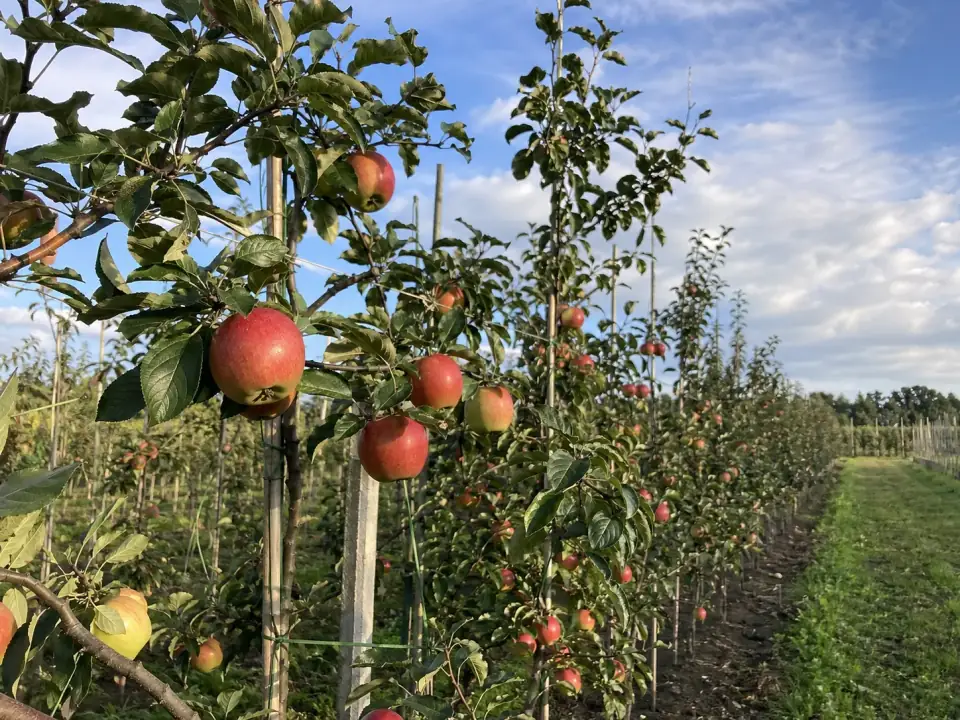
In short: an intensive orchard is planted on dwarfing rootstocks at 800 or more trees per hectare, trained on a trellis and usually drip-irrigated so that trees start bearing sooner. The state describes it more briefly: Government Decree No. 717 calls an intensive-type orchard a pome or stone fruit orchard with matched cultivar and rootstock combinations and a planting density of 800 plants per hectare or more. Below is a compact overview. Detailed calculations sit in separate articles, linked where they apply.
How an intensive orchard differs from a traditional one
The main difference is rootstock and density: an intensive orchard carries an order of magnitude more trees per hectare than a traditional one. The comparison draws on a page of the Ontario Ministry of Agriculture (OMAFRA, updated 31 March 2025) and on our nursery layouts.
| Parameter | Traditional orchard (low density) | Intensive orchard |
|---|---|---|
| Rootstock | Semi-vigorous and vigorous (MM.106, MM.111 and larger) | Dwarfing or growth-limiting: M9 for apple, Gisela 5 and 6 for sweet cherry |
| Trees per hectare | About 130–200 (layouts of 7.5 × 10.0 and 6.0 × 8.5 m) | 800 or more under Decree No. 717; on M9 our layouts give 2,381–3,571 |
| Training and support | Minimal pruning, free-standing tree | Specialised training; apple on M9 needs support for the life of the tree |
| Investment in trees per hectare | Lowest, needs cheap land | Higher: saplings, trellis, irrigation |
| Orchard life | About 40 years | OMAFRA advises dropping the lifetime-orchard idea: the cultivar can be changed without long lost production |
OMAFRA does not recommend planting low-density orchards today. Density is paid for in management: by the same source, fruit colour and size decline from shading at high density, so training and pruning are a required part of the system. Why apple on M9 needs a trellis is covered in the article on M9 rootstock.
When to expect a crop
An intensive orchard bears its first fruit in year 2 to 5 after planting, depending on the crop, rootstock and type of sapling.
| Crop and rootstock | What the source reports | Source |
|---|---|---|
| Apple on M9, unbranched sapling | Significant fruit in year 4 or 5 after planting | UMass Extension |
| Apple on M9, sapling with side branches | Comes into bearing earlier than an unbranched one but costs more | ISHS |
| Apple, super-intensive orchard on M9 | Commercial fruiting from year 3 (the blog author’s estimate) | bozos.ru, 2025 |
| Sweet cherry on Gisela 5 | Bears in year 2; overcropping gives small fruit, irrigation is essential | NYSHS; ISHS |
| Sweet cherry on Gisela 6 | Harvestable crop by year 3, full production by year 5 | Oregon State University |
That is why dense layouts use a knip sapling with side branches: it starts bearing sooner, although it costs more. For sweet cherry the choice between Gisela 5 and Gisela 6 changes both density and timing, see the article on Gisela 5 and Gisela 6. The figures in the table are benchmarks from foreign sources. Timing at your site depends on cultivar, weather and care, and is worth discussing with an agronomist before planting.
Planting layouts and density
For apple on M9 the layouts most often counted run from 3.5 × 1.2 to 3.5 × 0.8 m, which is 2,381 to 3,571 trees per hectare.
| Layout, m | Trees per hectare | Rate coefficient, at least |
|---|---|---|
| 3.5 × 1.2 | 2,381 | 1.4 |
| 3.5 × 1.0 | 2,857 | 1.7 |
| 3.0 × 1.0 | 3,333 | 1.7 |
| 3.5 × 0.8 | 3,571 | 3 |
The coefficients come from the federal orchard-laying subsidy rules (Decree No. 717, edition of 23.12.2025): above 1,250 plants per hectare at least 1.4, above 2,500 at least 1.7, above 3,500 at least 3. Rates and conditions are set by the region and are described in the article on orchard laying subsidies. The calculator returns the sapling count with a reserve for losses, and the logic is covered in How many saplings per hectare.
Sweet cherry layouts are less dense. According to Oregon State University (converted from trees per acre), Gisela 5 is planted at 1,240–1,980 trees per hectare and Gisela 6 at 740–1,235. The lower end for Gisela 6 falls below the 800-plant threshold of Decree No. 717, so check density in advance if you count on a subsidy.
Which cultivars to choose
Choose cultivars by sales channel and harvest window, and plant 3–5 cultivars per block with different ripening dates and pollinators in mind.
For autumn 2026 and spring 2027 the nursery offers 17 commercial apple cultivars on M9: the Gala group (Gala Royal) for the fresh market, storage cultivars (Fuji, Granny Smith) and premium ones (Pink Lady, Crimson Crisp). Apple is mostly self-incompatible, so a block is planted with 2–3 cross-pollinating cultivars that bloom together, or with an added pollinator. Selection criteria and groups are covered in Apple cultivars for a commercial orchard. For sweet cherry on Gisela 5 and 6 see the sweet cherry section.
What laying an orchard costs
The trade blog bozos.ru estimates laying a hectare of super-intensive orchard on M9 at RUB 3.5–5.5 million in 2025 prices, of which saplings are 30–40%.
The rest is split between trellis, drip irrigation, soil preparation and planting, care until fruiting, and design. Michurinsk State Agrarian University uses a different scale for central Russia: RUB 2,131 thousand per hectare for an intensive orchard on a trellis and RUB 2,957 thousand for a super-intensive one (journal Nauka i obrazovanie, 2024). Both figures are estimates, and only a quote gives the real sum. The sapling line can be calculated to the rouble: on our price list of 9 October 2026, category 3+ saplings at RUB 400 including VAT for a 3.5 × 1.0 m layout cost RUB 1,142,800 per hectare without a reserve for losses. The full cost structure and layout maths are in How much does a hectare of orchard cost, and current prices by cultivar are in the price list.
Where to start: the order of work
An orchard is laid in this order: site, layout and rootstock, cultivars, budget and support, sapling order, trellis with irrigation, planting.
- Check the site: soil analysis, a water source for irrigation, spring frost and hail risk, land category and permitted use. Agricultural land has its own rules, covered in An orchard on agricultural land.
- Choose the rootstock and layout and count the trees in the calculator.
- Pick 3–5 cultivars for your sales channel and harvest window, and add pollinators.
- Check the budget against How much does a hectare of orchard cost and look into support: orchard laying subsidies and the unified grant for farmers. The application procedure and document list are set by the regional ministry of agriculture, so confirm them before ordering a lot.
- Order saplings in advance: the minimum lot is 6,000 pieces, a lot from 1,000 pieces can be requested, and we state the small-lot price in the quote. Saplings are collected from the nursery in Sunzha village in the lifting windows of October–November and March–April, and each lot comes with a phytosanitary certificate.
- Install the trellis and drip irrigation before planting or together with it. Contractors do the installation, and we will point you to contractors for trellis, irrigation and hail netting.
- Plant the orchard in the lifting window. Discuss planting dates and care in the first years with an agronomist.
The nursery agronomist advises on cultivars, rootstocks, layouts and planting dates. On request we prepare a turnkey orchard project with partner contractors: design, site preparation, trellis, irrigation and planting. Scope, price and regions are quoted on request.
What to read before planting an orchard
- Money and land: orchard grant in 2026, an apple orchard as a business, an orchard on agricultural land.
- Building the orchard: planting month by month, trellis, drip irrigation, hail nets.
- Choosing cultivars: apple cultivars for the south, sweet cherry cultivars for the south, cultivars for long storage, fire blight and clean planting stock, a pick-your-own orchard.
- Working with the nursery: turnkey orchard planting with an agronomist and contractors, saplings for contractors and agronomists.
Need a lot calculation or agronomist advice?
Send the area, rootstock and planting layout. We will return the tree count with a reserve and the lot price from the price list, and advise on cultivars and timing. List prices apply from 6,000 saplings; small lots from 1,000 carry a surcharge.
Sources
- Government Decree of the Russian Federation of 14.07.2012 No. 717 (ed. 23.12.2025): definition of an intensive-type orchard and rate coefficients; orchard-laying amendments: Decree No. 1722 of 01.11.2025
- Ontario Ministry of Agriculture (OMAFRA), Apple rootstocks, updated 31 March 2025
- UMass Extension, High density apple; ISHS, Acta Horticulturae 514
- Oregon State University Extension, PNW 619; New York State Horticultural Society, New York Fruit Quarterly
- bozos.ru, “Average investment in an intensive apple orchard for 2025 in roubles”; Trunov, Bryukhina, Medelyaeva, Michurinsk State Agrarian University, Nauka i obrazovanie, 2024
- Price list of the Sady Stavropolya nursery for autumn 2026 and spring 2027, stock as of 9 October 2026
The essentials, in brief.
What is an intensive orchard in simple terms?
It is an orchard on dwarfing rootstocks with dense planting and a trellis that starts bearing earlier than usual. Government Decree No. 717 calls a pome or stone fruit orchard intensive when it has matched cultivar and rootstock combinations and a planting density of 800 plants per hectare or more.How many trees per hectare does an intensive orchard have?
At least 800 under Decree No. 717. On M9 we count layouts from 3.5 × 1.2 m (2,381 trees) to 3.5 × 0.8 m (3,571 trees). The exact number depends on the layout and the reserve for losses, and the calculator on the site returns it.How many years until an intensive orchard gives a crop?
It depends on the crop, rootstock and sapling. According to Oregon State University, sweet cherry on Gisela 6 gives a harvestable crop by year 3; according to NYSHS and ISHS, it bears in year 2 on Gisela 5. For apple on M9, UMass Extension gives year 4 or 5 for unbranched saplings, and the bozos.ru blog estimates commercial fruiting of a super-intensive orchard from year 3. These are benchmarks to discuss with an agronomist.Intensive or traditional orchard: which to choose?
An intensive orchard comes into bearing sooner and uses less land per tree, but needs more investment per hectare: trellis, irrigation and training. The Ontario Ministry of Agriculture (OMAFRA) does not recommend planting low-density orchards today.Does an intensive orchard need a trellis and irrigation?
Apple on M9 needs support for the life of the tree (OMAFRA, University of Maryland). Irrigation may be needed at high density, and sources (NYSHS, ISHS) call it essential for sweet cherry on Gisela 5. Contractors install the trellis, drip irrigation and hail netting, and we will point you to contractors.How much does it cost to lay a hectare of intensive orchard?
The bozos.ru blog estimates RUB 3.5–5.5 million per hectare in 2025 prices, and Michurinsk State Agrarian University gives RUB 2,131 thousand for a trellised orchard in central Russia. These are different scales, and only a quote gives the real sum. We calculate the sapling line from the price list.
Related material
- 01How many saplings you need per hectare: intensive orchard planting schemesThe number of saplings per hectare is set by the planting scheme, and the scheme is set by the rootstock. We cover the formula, give a density table and show how much to order in reserve.Read article
- 02How much it costs to lay a hectare of an intensive apple orchardThe cost structure of a hectare of intensive apple orchard per a trade blog, a different scale from Michurinsk university and an exact calculation of the sapling line from the nursery price list.Read article
- 03How to choose apple cultivars for a commercial orchardThe cultivar decides who buys your crop and when. We cover the criteria for choosing commercial apple cultivars for an intensive M9 orchard: market, timing, marketability, storage and pollination.Read article
Need saplings for your project?
We will match cultivars and rootstocks to your orchard scheme, price a lot from 6,000 units, and set a pickup window — fall 2026 or spring 2027.