Intensive orchard planting: the technology by month
An intensive orchard goes in in a strict order: soil analysis, site preparation, trellis and drip, planting, first-year care. Each stage is covered by timing, with figures from specialist sources.
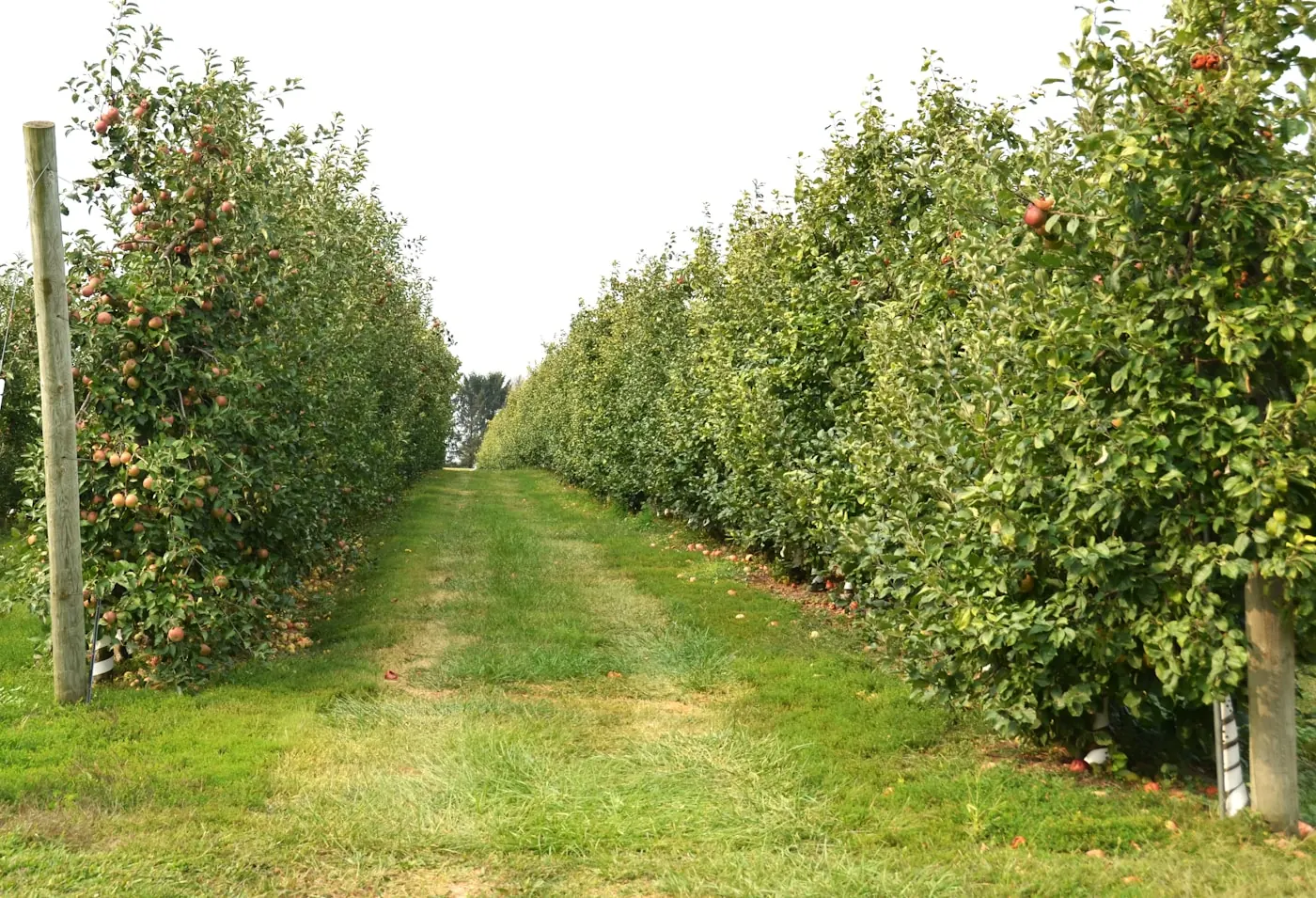
Planting an intensive apple orchard starts at least a year before the saplings go in. By planting day the soil must be analysed and fertilised, the site cleared of perennial weeds, and the trellis and drip lines in place. The order cannot be swapped: posts go in on an empty field, and saplings are tied to a finished support at planting. Below are the calendar and the technology of each stage.
Orchard planting calendar by month
Several seasons pass between soil analysis and the first harvest, each with its own work. The table puts them on one schedule, counted from the date you plan to plant.
| When | Work | What to order or book |
|---|---|---|
| 12 months or more before planting | Site choice, soil and water analysis | A laboratory, agronomist advice |
| Summer of the preparation year | Reserve saplings by cultivar and grade | A lot at the nursery, trellis posts |
| Late summer and autumn | Perennial weeds, phosphorus, potassium, lime, organics, plowing and subsoiling | Machinery and fertiliser |
| Winter | Design: planting layout, blocks, trellis, irrigation | Contractors for trellis and irrigation |
| March–April, or a season before autumn planting | Marking, posts, wire, irrigation mainlines | Installation, a pressure check |
| March–April or October–November | Planting | Lifting and transport of saplings |
| Right after planting | Tying to the support, pruning, first watering | Workers, water |
| First summer | Watering, a weed-free strip in the row | Herbicide or mechanical weeding |
| First autumn | Sod in the inter-rows, wire tension check after harvest | Grass seed for the inter-rows |
Soil analysis and site preparation a year before planting
Soil analysis is ordered a year before planting because phosphorus, potassium and lime go on in advance. The University of Wisconsin Extension (publication A3560) advises sampling a year before planting, one sample per block of uniform soil of no more than 4–5 acres, about 1.6–2 ha. It also says site preparation should start at least a year before planting.
For an intensive orchard the trade blog bozos.ru gives these benchmarks: a humus layer of 40–60 cm, pH 6.0–7.0, groundwater no closer than 1.5–2 m to the surface, a slope of 2–5 degrees. If the plot falls outside these limits, you need to know before choosing the cultivar and layout. Irrigation water goes to the laboratory too, since its composition decides the filters for the drip system.
Site preparation runs in this order: kill perennial weeds, apply fertiliser, then plow and loosen. The University of Wisconsin recommends sowing a cover crop for the winter after perennial weed control and subsoiling 2–3 ft (60–90 cm) in two perpendicular directions.
According to bozos.ru, an intensive orchard gets 40–80 t/ha of manure or compost and is plowed to 40–50 cm. The soil analysis refines these values, so doses are not set without laboratory results. The analysis results help the nursery agronomist choose the rootstock and the layout.
Trellis and drip go in before the saplings
Trellis and drip irrigation are installed before planting because the Washington State University guidance (WSU, EM117E) requires the trellis to go in ahead of the trees. Posts and wire go up on an open field, machinery does not trouble the saplings, and an M9 tree is tied to its support from day one.
Wooden posts should be ordered early: Ontario Apple Growers in their trellis guide recommend doing it a year ahead. The support design, post spacing and materials per hectare are covered in trellis for an intensive apple orchard, and mainline and drip-line layouts in drip irrigation for an intensive orchard. If hail nets are planned for the plot, post height is calculated early, as described in hail nets for an orchard.
The nursery does not sell or install trellis and irrigation. Design, site preparation, trellis, irrigation and planting are done by the nursery’s partner contractors within turnkey orchard planting, and the scope, price and regions are given in a quote on request.
We will calculate an orchard for your plot
Send the area, region and soil analysis results. The nursery agronomist will propose cultivars, rootstock, layout and planting dates.
Planting window: March–April or October–November
Saplings are planted in spring before bud break or in autumn 3–4 weeks before sustained frost, as bozos.ru describes. The nursery releases saplings in October and November and in March and April, which matches both windows. The difference between spring and autumn planting is covered in when to plant saplings: spring or autumn.
At planting the graft union stays 5–10 cm above the soil, as both bozos.ru and the Canadian organisation Perennia state. Perennia advises pruning the tree soon after planting.
The University of Wisconsin advises ordering trees one to two years before planting. A lot at our nursery is secured by a contract and a 30% payment, and stock by cultivar and grade is in the price list: reserve on the pre-order page. Rootstocks, cultivars and grades are described on the rootstocks and apple pages.
First year: watering, a clean strip, sod
The first year has three jobs: water, keep the row strip clean, and secure the support. The Netafim apple protocol allows about 10 l per tree per day in year one: four 1 l/h drippers run for 2.5 hours. This is a manufacturer’s example, and the agronomist adjusts the rate to weather and soil.
A strip 0.8–1.2 m wide in the row stays free of grass, and sod is sown in the inter-rows in the first autumn, writes bozos.ru. After harvest the wire tension is checked: Ontario Apple Growers recommend doing it every year after picking.
How many saplings to order and when
The sapling count follows the planting layout: a 3.5 × 1.0 m layout takes 2,857 trees per hectare, and at the price list of 9 October 2026 grade 3+ for such an orchard costs RUB 1,142,800 per hectare including VAT, with no reserve. The sapling calculator works it out for your layout, and the article how many saplings per hectare explains the formula and the reserve. The rest of the cost structure is in how much a hectare of intensive orchard costs.
The list price applies from a lot of 6,000 saplings, and smaller lots from 1,000 are possible with a surcharge, priced in the quote. If you plant orchards for clients, see saplings for contractors.
Sources
- University of Wisconsin Extension, A3560, “Planning and Establishing Commercial Apple Orchards in Wisconsin”
- bozos.ru, “Basic principles of intensive orchard planting”
- Perennia, “Planting and care of young orchards”
- Netafim, “Apple protocol”
- Washington State University Extension, EM117E
- Ontario Apple Growers, “Building trellis support systems for high density orchards”
- Sady Stavropolya price list, stock as of 9 October 2026
The essentials, in brief.
When should intensive orchard planting start?
Planting an intensive orchard starts at least a year before the saplings go in. The University of Wisconsin advises soil sampling and applying phosphorus, potassium and lime a year before planting, and ordering trees one to two years ahead.What goes in first, the trellis or the saplings?
The trellis and drip lines go in before planting. Posts are easier to set on an empty plot, and saplings on M9 are tied to a finished support on planting day.When should apple on M9 be planted, spring or autumn?
Apple on M9 is planted in spring before bud break or in autumn 3–4 weeks before sustained frost, as bozos.ru describes. The nursery releases saplings in October and November and in March and April.How much do saplings cost for a hectare on a 3.5 × 1.0 m layout?
A 3.5 × 1.0 m layout needs 2,857 trees per hectare. At the price list of 9 October 2026, grade 3+ saplings come to RUB 1,142,800 including VAT with no reserve, and the calculator works out an exact figure.Who does the work when an orchard is planted turnkey?
The nursery supplies saplings, and its agronomist advises on cultivars, rootstock, layout and dates. Partner contractors do the design, site preparation, trellis, irrigation and planting, with scope, price and regions given in a quote.
Related material
- 01Intensive orchard: what it is, layouts, cultivars and costsWhat an intensive orchard is under Government Decree No. 717, how it differs from a traditional one, which layouts and cultivars to count, what the costs consist of and the order of planting.Read article
- 02When to plant fruit saplings: spring or autumnAutumn or spring is the perennial question of starting an orchard. We cover how autumn and spring planting of bare-root saplings differ, the risks of each window, and what to choose in southern Russia.Read article
- 03How many saplings you need per hectare: intensive orchard planting schemesThe number of saplings per hectare is set by the planting scheme, and the scheme is set by the rootstock. We cover the formula, give a density table and show how much to order in reserve.Read article
Need saplings for your project?
We will match cultivars and rootstocks to your orchard scheme, price a lot from 6,000 units, and set a pickup window — fall 2026 or spring 2027.