Trellis for an intensive apple orchard: design and a 1 ha calculation
An apple on M9 needs a support from day one: the roots are shallow and the tree cannot hold a crop alone. This covers the design, posts, wire and materials per hectare, with figures from specialist sources.
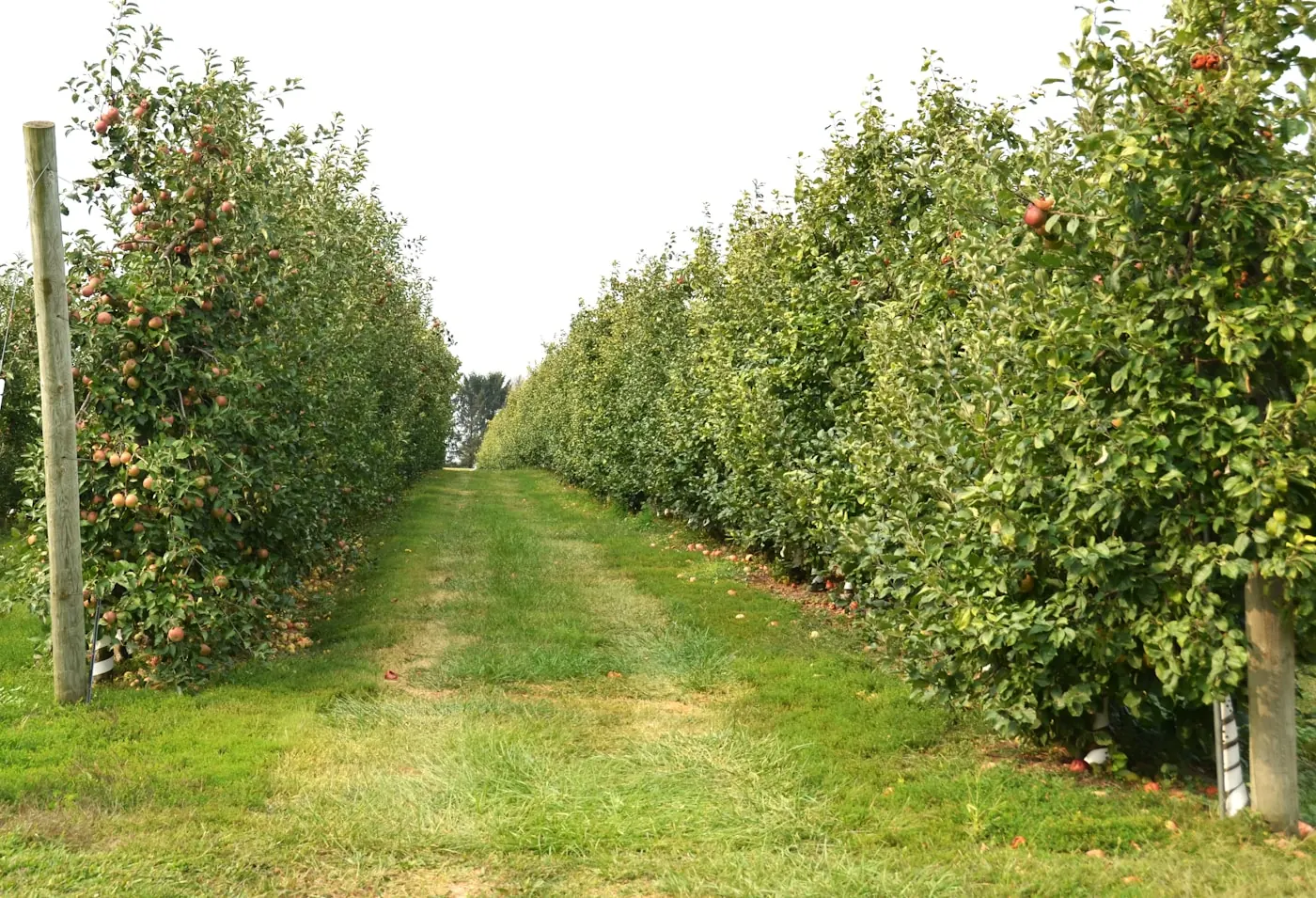
A trellis for apple on M9 consists of end posts, in-line posts, anchors and three or four levels of galvanised wire. For an orchard with 3.5 m rows, one hectare takes about 11,430 m of wire, about 350 in-line posts and 58 end posts with anchors. We calculate these from the sizes university services recommend. A design refines them for the terrain, tree height and planting layout.
Why apple on M9 needs a trellis
Apple on M9 must have a trellis because this rootstock has a shallow, fibrous root system, and an unsupported tree leans under the weight of the crop. Penn State Extension writes that dense orchards are built on dwarfing, precocious rootstocks that need external support, so it goes in at the very start. The rootstock is covered in M9 for an intensive orchard, and the saplings on it are on the rootstocks page.
The trellis goes in before planting: Washington State University guidance (EM117E) requires it ahead of the trees. Posts are driven on an empty field, and the sapling is tied to a finished support on planting day. The rest of the sequence is in intensive orchard planting by month.
Trellis design: wire levels and stakes
An intensive-orchard trellis supports the tree at several levels along its height. The trade blog bozos.ru describes posts every 6–10 m, three or four wire levels and a stake at every tree. In the Penn State Extension example for tall spindle, four wires run at 2.5, 5.5, 7.5 and 9.5 ft above the ground, about 0.8, 1.7, 2.3 and 2.9 m.
The trunk is fastened to the support every 2–2.5 ft (60–75 cm) up its height, and the top of the leader stands no more than 1 ft (30 cm) above the top wire, advises Ontario Apple Growers. Tree height should not exceed 90% of the row spacing: at 3.5 m rows that is about 3.15 m. The sapling calculator works out the layout and trees per hectare.
Trellis posts, anchors and wire
Trellis posts are 14 ft (about 4.3 m) long: end posts 5–6 in (13–15 cm) in diameter, in-line posts 4–5 in (10–13 cm). The table gives the sizes from Penn State Extension and Ontario Apple Growers.
| Element | Size | Depth and spacing |
|---|---|---|
| End post | 5–6 in (13–15 cm) diameter, 14 ft (4.3 m) long | set 4 ft (1.2 m) deep |
| In-line post | 4–5 in (10–13 cm) diameter, 14 ft (4.3 m) long | set 3–4 ft (0.9–1.2 m) deep, at most 30 ft (9 m) apart |
| Anchor post | 5–6 in (13–15 cm) diameter | driven 4 ft (1.2 m) or more, at 60–70 degrees |
| Wire | 12.5 gauge (about 2.5 mm), high-tensile galvanised, class 3 | tension 200–250 lb (90–113 kg) |
A 5 in post is 50% stronger than a 4 in post, writes Penn State Extension. Ontario Apple Growers set post depth at a quarter of its length, at least 2.75 ft (0.84 m), and put the ideal row length at about 500 ft (150 m). Driven posts hold 50% better in the ground than posts set in augered holes.
Anchors are driven 4 ft or deeper at 60–70 degrees, and an end post is reinforced with an H-brace 10–12 ft (3–3.7 m) long where needed. Penn State notes that treated wooden tie-back posts hold better than screw-in anchors. The wire is checked every year after harvest, and the drip line hangs on the bottom wire, as in drip irrigation for an intensive orchard.
Wooden posts are ordered a year before installation. If hail nets are planned, Ontario Apple Growers advise 16 ft posts (about 4.9 m): details in hail nets for an orchard.
Trellis materials per 1 ha
For 3.5 m rows and four wires, a hectare needs about 11,430 m of wire, around 440 kg, about 350 in-line posts, 58 end posts and 58 anchors. This is our calculation for 100 m rows, not a design for a specific plot.
| Item | Assumptions | Per 1 ha |
|---|---|---|
| Row length | 10,000 m² ÷ 3.5 m | about 2,857 m, about 29 rows of 100 m |
| Wire | 4 strands, 2.5 mm, about 38.5 g per metre | about 11,430 m, about 440 kg |
| In-line posts | 12 per row, about 7.7 m apart | about 350 |
| End posts | 2 per row | 58 |
| Anchors | one per end post | 58 |
The trade blog bozos.ru gives a cost guide: a trellis runs RUB 600,000–1,100,000 per hectare, 15–20% of orchard planting costs. The 2025 estimate is indicative. The nursery does not quote trellis prices, and a contractor prepares the estimate for your plot. The rest of the cost structure is in how much a hectare of intensive orchard costs.
We will calculate the orchard and find a contractor
Send the area, region and planting layout. The nursery agronomist will propose rootstock, cultivars and dates, and a contractor we work with installs the trellis.
Common trellis mistakes
Most trellis failures come from three points: the row end, post diameter and wire tension. The list draws on Penn State Extension, Ontario Apple Growers and WSU.
- Posts of small diameter. A 5 in post is 50% stronger than a 4 in post, and the row ends get a size larger.
- Weak row ends. End posts and anchors carry the load, so they are set 4 ft deep and anchors go in at 60–70 degrees.
- Posts in augered holes instead of driven. A driven post holds 50% better in the ground.
- A trellis after planting. The support goes in before the trees, or posts have to be driven between the rows of a finished orchard.
- No tension checks. Wire is tightened to 200–250 lb and checked after every harvest.
- No height reserve for nets. If nets are planned, posts are 16 ft long from the start.
What the nursery does and what the contractor does
The Sady Stavropolya nursery does not sell or install trellis, posts or wire. We supply apple saplings on M9, advise on cultivars, rootstocks, layouts and planting dates, and bring in partner contractors for trellis, irrigation and nets. Orchard design, site preparation, trellis, irrigation and planting can come as one package: the terms are on the page turnkey orchard planting, with scope, price and regions given in a quote on request.
Saplings for a trellised orchard are on the apple page, and a lot for your planting is secured through pre-order.
Sources
- Penn State Extension, “Apple trellis construction for high-density orchard systems”
- Ontario Apple Growers, “Building trellis support systems for high density orchards”
- Washington State University Extension, EM117E
- bozos.ru, “Basic principles of intensive orchard planting”
- bozos.ru, investment estimate for an intensive apple orchard, 2025
- Materials per hectare: Sady Stavropolya calculation from the sizes in the sources above
The essentials, in brief.
Does apple on M9 need a trellis?
Yes, a trellis for apple on M9 is required. The rootstock’s roots are shallow, and an unsupported tree leans under the weight of the crop. Penn State Extension writes that dwarfing, precocious rootstocks need external support.What posts does an intensive orchard trellis need?
Penn State Extension recommends posts 14 ft (4.3 m) long. End posts are 5–6 in (13–15 cm) in diameter set 4 ft deep; in-line posts are 4–5 in (10–13 cm) set 3–4 ft deep, at most 30 ft (9 m) apart.What wire should a trellis use?
A trellis uses high-tensile galvanised wire of 12.5 gauge (about 2.5 mm), class 3. Tension is 200–250 lb (90–113 kg) and should be checked every year after harvest.How much wire and how many posts does a hectare of trellis need?
For 3.5 m rows and four wires, a hectare needs about 11,430 m of wire (about 440 kg), around 350 in-line posts and 58 end posts. This is the nursery’s calculation for 100 m rows, and a plot design refines the count.How much does a trellis cost per hectare?
The trade blog bozos.ru, in a 2025 estimate, gives RUB 600,000–1,100,000 per hectare, 15–20% of planting costs. It is a guide, and a contractor prepares the estimate for the plot.Does the nursery sell trellis and posts?
No, the Sady Stavropolya nursery does not sell or install trellis. It supplies saplings, gives agronomist advice and brings in partner contractors for trellis, irrigation and nets.
Related material
- 01Intensive orchard: what it is, layouts, cultivars and costsWhat an intensive orchard is under Government Decree No. 717, how it differs from a traditional one, which layouts and cultivars to count, what the costs consist of and the order of planting.Read article
- 02M9 rootstock for apple: traits and when to choose itThe dwarfing M9 rootstock is the backbone of an intensive apple orchard: early fruiting, dense planting, predictable per-tree economics. We cover its traits, schemes and limits.Read article
- 03How much it costs to lay a hectare of an intensive apple orchardThe cost structure of a hectare of intensive apple orchard per a trade blog, a different scale from Michurinsk university and an exact calculation of the sapling line from the nursery price list.Read article
Need saplings for your project?
We will match cultivars and rootstocks to your orchard scheme, price a lot from 6,000 units, and set a pickup window — fall 2026 or spring 2027.