An orchard for pick-your-own and agritourism: how to plant it and which cultivars to choose
Visitors pick the fruit themselves, so a pick-your-own orchard is built around a long season and trees a hand can reach. We cover the rootstock, cultivars by ripening window and the agritourism grant.
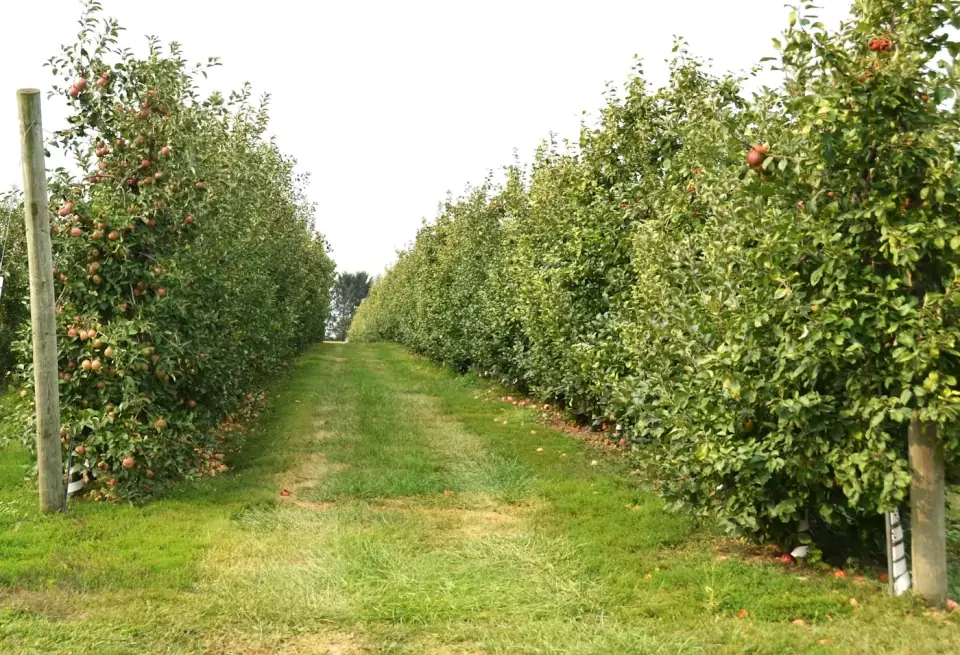
Pick-your-own rests on a simple arrangement. The visitor comes to the orchard and picks the fruit. That puts two demands on the owner. There must be fruit for the whole season of receiving guests, and the fruit must be within reach of someone with no experience. The questions that follow are the type of tree, the cultivar mix and the size of the sapling lot, and these are what we cover. Land use, insurance and liability to guests are for a lawyer and the local administration, and they are not covered here.
Which tree suits pick-your-own
A low tree on a dwarfing rootstock suits pick-your-own, because its fruit is picked from the ground.
Orchard planning guides, for example from Penn State Extension, describe two points. Low trees on a dwarfing rootstock are picked without ladders, and early, mid and late cultivars lengthen the season. For apple in our nursery that means M9. As we wrote in the article on the M9 rootstock, a tree grafted on it grows to 2-2.5 m and starts fruiting in the 2nd to 3rd year after planting.
M9 comes with a condition. According to OMAFRA, the Ontario ministry of agriculture, and the University of Maryland, the rootstock needs support for the whole life of the tree, so the orchard is planted on a trellis. The layout on M9 from the same article is 3.0-3.5 m between rows and 0.8-1.2 m within the row. Discuss the alley width for your visitor flow with an agronomist when the layout is calculated.
Trees are worth buying as knip trees with side branches. According to ISHS, branched trees come into fruiting earlier than unbranched maidens, and guests need an orchard with fruit as early as possible. More on such saplings is on the page about knip apple saplings.
How to stretch the picking season with cultivars
The pick-your-own season is stretched with cultivars of different ripening times, from summer to late autumn.
Each cultivar fruits in its own window, so an orchard of a single cultivar is open to guests for a short time. Below are 15 cultivars on M9 from our stock, sorted by ripening window, with what the visitor sees and tastes. The dates themselves depend on the year and the site and are discussed when the orchard is calculated.
| Window | Cultivars | What the visitor gets |
|---|---|---|
| Summer | Geneva, Williams’ Pride | Geneva ripens in midsummer and tastes tart-sweet. It keeps for a very short time, so the fruit is eaten at once. Williams’ Pride ripens unevenly, and one row is picked over several rounds. |
| Early autumn | Gala Devil, Royal Gala, Gala Schniga Red | Sweet, crisp, juicy fruit. Gala Devil and Gala Schniga Red have an intense red colour, and on Gala Devil it appears earlier than on other early clones. |
| Midseason | Modì, Jeromine, Golden Delicious Reinders | Modì is crisp and sweeter than Gala but with good acidity. Jeromine is dark red with white, sweet, low-acid flesh. Reinders has a smoother skin than the original Golden Delicious. |
| Mid-late | Crimson Crisp, Ambrosia | Crimson Crisp holds its fruit on the tree for a long time, so picking can be stretched. Ambrosia gives glossy red fruit with a mild sweet taste and low acidity. |
| Late | Greenstar, Fuji, Granny Smith, Story Inored | Greenstar has yellow-green, very firm and juicy fruit, Granny Smith is green, and Story Inored has yellow skin with a purple-red blush. They need a long season and a warm autumn. |
| Latest | Pink Lady | The fruit is picked in late October and early November. It needs a hot climate and an autumn without early frosts. |
Cultivars of different windows also help with pollination, provided they bloom at the same time. Gala clones pollinate each other poorly and need partners such as Golden Delicious, Granny Smith or Fuji, so three Gala clones in one block do not stand in for each other. Check the bloom overlap with an agronomist. What to consider in the south about heat, frost and scab is covered in the article on apple cultivars for southern Russia, and Geneva is susceptible to fire blight, with cultivar ratings collected in the article on fire blight in apple trees.
What cherry adds
Cherry opens the pick-your-own season earlier than apple, and cultivars of different timing give it a stretch of its own.
Sweet Lorenz ripens about 10 days after Burlat, Summit about 16 days after Burlat and Lapins 10-14 days after Bing. The reference points differ by cultivar, so these dates do not add up to one calendar, with more in the article on sweet cherry cultivars for the south. In stock are Lapins, Summit, Ferrovia, Samba and Sweet Lorenz.
Cherry is grown on Gisela 5 or Gisela 6. According to Oregon State University, a tree on Gisela 5 reaches 50-60% of full size and on Gisela 6 about 80-85%, so Gisela 5 is closer to picking from the ground. It needs irrigation, and overcropping makes the fruit small. The choice between the rootstocks is covered in the article on Gisela 5 and Gisela 6. Samba, Sweet Lorenz, Summit and Ferrovia are self-sterile and need a pollinizer. Lapins is self-fertile and pollinates other cultivars, and the bloom overlap is still checked.
How many saplings to take and when to collect them
Our nursery price list applies from 6,000 saplings, which is enough for about 1.5-2.4 ha at a density of 2,500-4,000 trees per hectare.
As of 9 October 2026 an apple sapling on M9 costs RUB 360 in grade 1+, RUB 400 in grade 3+ and RUB 450 in grade 5+. The price is the same for every cultivar and includes VAT. Sweet cherry on Gisela 5 and Gisela 6 costs RUB 800. The price list applies from 6,000 saplings in steps of 250 per cultivar. Lots from 1,000 saplings are possible with a surcharge, and we will give the small-lot price in the quote.
A pick-your-own orchard is often smaller than a commercial one, and a small lot is routine here. A thousand saplings at the same density take 0.25-0.4 ha. Prices are collected on the price page, the calculator will work out the lot, and the general rule on trees per hectare is in the article on saplings per hectare.
Saplings are handed over by pickup only, in the village of Sunzha, ul. Traktovaya, 17. Lifting windows fall from October to November and from March to April, and each lot comes with a phytosanitary certificate. Payment is 30% on signing and the balance 10 days before shipment. Which window to choose is covered in the article on planting in spring or autumn. The price list and pickup are the same for every region, including neighbouring Kabardino-Balkaria, which by the Rosselkhozbank rating for 2023 gave about a quarter of the Russian harvest of apples, pears and quince.
What is known about the “Agrotourism” grant
The “Agrotourism” grant gives small agribusiness up to RUB 10 m for tourist infrastructure. The list of grant costs is set by Order No. 88 of the Ministry of Agriculture of Russia of 17.02.2026: fruit saplings are not named there as a separate item, but the list of reimbursable costs (up to 50%, no more than RUB 5 m) includes landscaping of the territory at tourist facilities, including planting perennial plants.
The grant was introduced by Government Decree No. 2309 of 16 December 2021 and has run since 2022, as the Government of Russia reports. The costs include building or repairing premises for tourists, improving the adjoining territory, entertainment infrastructure, and tourist equipment and inventory. The project must pay back within five years, the applicant’s own contribution is from 10% to 25% depending on the size of the grant, and the selection is run by the Ministry of Agriculture. The applicant must be an agricultural producer (not a personal subsidiary plot) in the “small enterprise” or “microenterprise” category, registered and operating for more than 12 months in a rural area or rural agglomeration, with additional OKVED codes of classes 55, 56, 79 or 93; the grant is awarded once, project costs cannot be paid from other state support measures, and the applicant must operate as an agricultural producer for at least 5 years (appendix No. 12 to the State Programme, Decree No. 717, as amended by Decree No. 934 of 24.07.2026). Since 1 August 2026, projects to be implemented from 1 January 2027 need a conclusion of the regional working group.
From 1 January 2026 the grant is part of the federal project “Development of small agribusiness”. The 2026 federal budget includes a further RUB 730 m to continue the “Agrotourism” grant (Government statement of 12 January 2026).
Planting an orchard is not named as a separate item in the list of costs in Order No. 88 of the Ministry of Agriculture of Russia of 17.02.2026. Whether a commercial pick-your-own orchard falls under these costs is decided by the competition commission and the region, so check this with your regional ministry of agriculture before applying. Check the terms of the current competition with the Ministry of Agriculture of Russia as well. The support measures that cover orchard planting are described in the article on subsidies for orchard planting.
Where to start
Start with a calculation, because the area, the region and the way you receive guests set both the cultivar mix and the number of trees.
The nursery agronomist will advise on cultivars, rootstocks, layout and planting dates. We build turnkey orchards with partner contractors, and we give the scope of work, the price and the regions on request. For the calculation, have the plot area, the region, the picking windows you need and the lot size ready. If you are unsure of the size, start with a lot from 1,000 saplings. Cultivars in stock are on the pages for apple and sweet cherry.
Planning a pick-your-own orchard?
Tell us about the plot, the region and how you will receive guests. The agronomist will choose cultivars by ripening window and calculate the lot, including lots from 1,000 saplings.
The essentials, in brief.
Which trees suit a pick-your-own orchard?
Low trees on a dwarfing rootstock. Orchard planning guides describe such trees as picked from the ground without ladders. In our nursery these are apple on M9, about 2-2.5 m tall, and sweet cherry on Gisela 5 or Gisela 6. A tree on M9 needs a trellis.How can the pick-your-own season be stretched?
Plant cultivars of different ripening times. Of the apples in stock, Geneva ripens in midsummer, Gala and Modì in autumn, Granny Smith, Fuji and Greenstar late, and Pink Lady in late October and early November. Cherry opens the season earlier than apple.Does the “Agrotourism” grant cover buying saplings?
Order No. 88 of the Ministry of Agriculture of Russia of 17.02.2026 names premises for tourists, improving the territory, entertainment infrastructure and tourist equipment among the costs. Fruit saplings are not named as a separate item, but the list of reimbursable costs (up to 50%, no more than RUB 5 m) includes landscaping of the territory at tourist facilities, including planting perennial plants. Whether a commercial pick-your-own orchard falls under these costs is decided by the competition commission and the region, so check this with your regional ministry of agriculture before applying. The grant is up to RUB 10 m.How many saplings does a pick-your-own orchard need?
The price list applies from 6,000 saplings, which at 2,500-4,000 trees per hectare is 1.5-2.4 ha. Lots from 1,000 saplings are possible with a surcharge, and we will give the small-lot price in the quote. As of 9 October 2026 an apple sapling on M9 costs RUB 360 in grade 1+ and sweet cherry RUB 800.When will an orchard on M9 start fruiting?
According to the description of the M9 rootstock, fruiting starts in the 2nd to 3rd year after planting. The timing depends on the cultivar, the sapling grade and the care, so plan the opening date for guests with some margin.Can I order a turnkey orchard?
The nursery agronomist will advise on cultivars, rootstocks, layout and planting dates. We build turnkey orchards with partner contractors, and we give the scope of work, the price and the regions on request.
Related material
- 01Intensive orchard: what it is, layouts, cultivars and costsWhat an intensive orchard is under Government Decree No. 717, how it differs from a traditional one, which layouts and cultivars to count, what the costs consist of and the order of planting.Read article
- 02M9 rootstock for apple: traits and when to choose itThe dwarfing M9 rootstock is the backbone of an intensive apple orchard: early fruiting, dense planting, predictable per-tree economics. We cover its traits, schemes and limits.Read article
- 03Apple cultivars for southern Russia: what to plant in an intensive orchardHeat, frost and scab limit cultivar choice in the south. We go through 15 apple cultivars on M9 in ripening order and say which ones need a long summer and a warm autumn.Read article
Need saplings for your project?
We will match cultivars and rootstocks to your orchard scheme, price a lot from 6,000 units, and set a pickup window — fall 2026 or spring 2027.