Fire blight in apple trees: resistant cultivars and clean saplings
Fire blight of apple is caused by the bacterium Erwinia amylovora, and in Russia it is a quarantine pest. We cover how the disease looks, what Rosselkhoznadzor data show, how cultivars and the M9 rootstock are rated for susceptibility and what you can do when buying saplings.
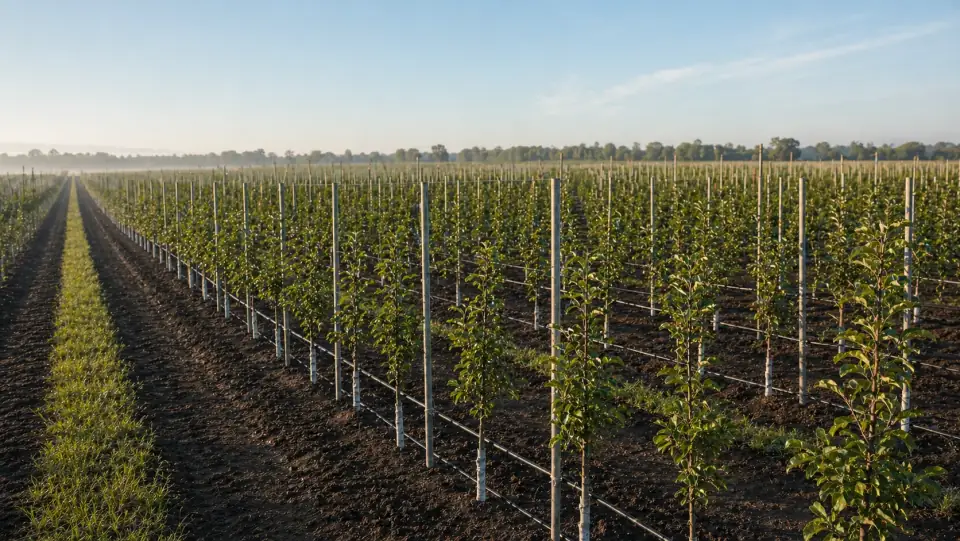
Fire blight is caused by the bacterium Erwinia amylovora, and in Russia it is a quarantine pest. A grower needs to know how the disease looks, how it spreads and which cultivars and rootstocks suffer more. Below are the signs, the status of the disease according to Rosselkhoznadzor, cultivar ratings from US tables and the measures you can take when buying saplings. There are no preparations or doses here, as those are set by official documents and product labels.
What fire blight looks like
Fire blight attacks blossoms, shoots, branches and the rootstock, and the affected parts look scorched.
In its fact sheet Ohio State University lists blossom blight, shoot tips bent into a shepherd’s crook, cankers on branches and rootstock blight. The last can kill a tree by girdling it at the base.
The bacterium overwinters in cankers on the bark. In spring, warm wet weather at bloom drives infection, and the pathogen is carried by rain, pollinators and pruning. Other routes are listed on the Rosselkhoznadzor page. They are infected plants, cuttings and grafting material, fruit, tools, containers, wind, insects and birds. Planting material is on that list, so clean saplings are the first line of defence.
Quarantine status in Russia
Fire blight of fruit crops is a quarantine pest of limited distribution, and outbreaks are fixed as quarantine zones.
The disease is on the unified EAEU quarantine list approved by decision No. 158 of the EEC Council of 30 November 2016. According to the national report for 2024, zones covered 71 municipal districts in 19 regions with an area of 512.4 thousand ha. In 2024 seven new zones on 71.1 thousand ha were added, and three zones on 9,893.1 ha were abolished. The disease was found for the first time in Nizhny Novgorod Oblast.
| Indicator | 2023 | 2024 |
|---|---|---|
| Municipal districts with zones | 65 | 71 |
| Regions | 19 | 19 |
| Area of zones, thousand ha | 451.2 | 512.4 |
The 2023 figures are taken from the report for that year. That year outbreaks were found for the first time in Ryazan Oblast and Kabardino-Balkaria, and the report calls fire blight a serious threat to horticulture and nurseries.
Zones can be lifted. In Tula Oblast Rosselkhoznadzor abolished a quarantine zone on 22 August 2025, after three years without detection of the disease.
What M9 susceptibility means
M9 is highly to extremely susceptible to fire blight, and infection of the rootstock can kill the tree.
This rating is given by OMAFRA, the Ontario agriculture ministry and the University of Maryland. The scion cultivar does not change this susceptibility. If infection reaches the rootstock, its rating decides the fate of the tree whatever the cultivar.
For an orchard on M9 this leads to practical measures.
- Buy saplings with a certificate for the lot and inspect them on receipt.
- Walk the orchard in spring and summer, looking for the signs described in the first section.
- Disinfect tools when pruning and remove affected wood on specialist advice.
Intensive orchards are planted on M9 for early fruiting and dense planting, and the details are in the article on the M9 rootstock. Rootstock susceptibility belongs in the orchard protection plan, and it does not cancel those advantages.
What the cultivar ratings show
In US tables Gala, Granny Smith, Fuji and Pink Lady are among the most susceptible cultivars, while Williams’ Pride is rated milder.
The ratings come from US extension tables and reflect US conditions. For your orchard they remain a guide. PNW Handbooks use a scale from 1 to 4, where 4 means the highest susceptibility. Below are the rows for the cultivars in our stock that have ratings.
| Cultivar | Rating | Source |
|---|---|---|
| Gala | 4 of 4, highly susceptible | PNW Handbooks, Cornell via eXtension |
| Granny Smith | 4 of 4, highly susceptible | PNW Handbooks, Cornell via eXtension |
| Fuji | 4 of 4, highly susceptible | PNW Handbooks, Cornell via eXtension |
| Pink Lady | 4 of 4 | PNW Handbooks |
| Golden Delicious | 3 of 4, susceptible | PNW Handbooks, Cornell via eXtension |
| Geneva | Highly susceptible | Khan Lab, Cornell |
| Ambrosia | Susceptible | Khan Lab, Cornell |
| Crimson Crisp | Moderately resistant per Cornell, moderately susceptible per Penn State | Khan Lab, Cornell, Penn State Extension |
| Williams’ Pride | Moderately resistant to resistant | Khan Lab, Cornell |
These tables give no separate ratings for Royal Gala, Devil Gala, Gala Schniga Red, Golden Delicious Reinders, Modì, Inored Story, Greenstar and Jeromine, so they cannot be compared on this trait. For Royal Gala Rutgers University lists susceptibility to scab, fire blight and powdery mildew.
For Geneva, susceptibility to fire blight is also noted by VNIISPK, the Russian fruit breeding institute. A cultivar rating does not cancel the susceptibility of the rootstock, so even a cultivar with a milder rating stays on a susceptible rootstock on M9. Discuss how market demand weighs against risk with the agronomist, and the general approach to choosing is described in the article on cultivars for a commercial orchard.
Clean saplings when you buy
Protection of an orchard from fire blight starts at purchase, because planting material is among the routes of infection.
Every lot comes with a phytosanitary certificate. Which other documents to ask any nursery for is described in the articles on sapling documents and the nursery selection checklist. A certificate does not replace inspection and hygiene in the orchard.
When you receive a lot, check three things.
- The certificate for the lot, the delivery note and the tags with cultivar and rootstock.
- The shoot tips, looking for dried or crook-shaped ones.
- The bark on the trunk and at the graft union, looking for cankers.
If anything raises doubt, show the material to a specialist before planting. The agronomist handles the lot preparation and the range, and also selects the layout and planting dates.
As of 9 October 2026 an apple sapling on M9 costs RUB 360 in grade 1+, RUB 400 in grade 3+ and RUB 450 in grade 5+. The price is the same for every cultivar and includes VAT. The price list applies from 6,000 saplings in steps of 250 per cultivar. Lots from 1,000 saplings are possible with a surcharge, and we will give the small-lot price in the quote. See current prices in the price list and count saplings per plot in the calculator.
The lot is handed over on pickup from the village of Sunzha, and for farms in Rostov Oblast that is about 410 km in a straight line.
What to do if you suspect fire blight
Fire blight is a quarantine pest, so it is best to report a suspicion to the regional office of Rosselkhoznadzor and follow its instructions.
Ohio State University recommends cutting affected wood at least 10 cm below the visible edge of dieback and disinfecting tools between cuts. Preparations are applied only according to the label. Schemes and doses are not given here, because they depend on the preparation, the stage of the tree and the current lists of permitted products.
Official information on fire blight is published by Rosselkhoznadzor and in the national reports on quarantine status. Decisions for a specific orchard, including cultivars, rootstock and protection, should be taken together with the agronomist.
Choose cultivars and prepare the lot
Tell us about the site and the cultivars, and the agronomist will advise how to account for fire blight risk when building the range. We will prepare the lot with a phytosanitary certificate.
The essentials, in brief.
What is fire blight of apple?
It is a disease caused by the bacterium Erwinia amylovora. It attacks blossoms, shoots, branches and the rootstock, and in Russia it is a quarantine pest of limited distribution.How is fire blight of apple treated?
Measures for a quarantine pest are set by Rosselkhoznadzor, and a suspicion is best reported to its regional office. Ohio State University recommends cutting affected wood at least 10 cm below the visible edge of dieback, disinfecting tools and applying preparations only according to the label.Which apple cultivars suffer less from fire blight?
According to US tables, Williams’ Pride is rated moderately resistant to resistant, and for Crimson Crisp the ratings differ. Gala, Granny Smith and Fuji are highly susceptible in the same tables. These data come from the US and serve as a guide for your orchard.Is fire blight dangerous for the M9 rootstock?
Yes. OMAFRA and the University of Maryland rate M9 as highly to extremely susceptible to fire blight. Infection of the rootstock can kill the tree, so clean saplings and inspection matter in an orchard on M9.How can I check that saplings are clean?
Check the certificate for the lot, the delivery note and the cultivar and rootstock tags, and on receipt inspect the shoot tips and the bark on the trunk. Dried, crook-shaped tips and cankers on the bark are a reason to show the material to a specialist before planting.
Related material
- 01Intensive orchard: what it is, layouts, cultivars and costsWhat an intensive orchard is under Government Decree No. 717, how it differs from a traditional one, which layouts and cultivars to count, what the costs consist of and the order of planting.Read article
- 02Documents for saplings: what to check when buying a lotA lot of saplings without documents is a blind purchase: the cultivar, rootstock and health status are all unknown. We cover which papers to request from the seller and what each one proves.Read article
- 03How to choose a sapling nursery for a commercial orchard: a checklistAn inspection checklist for a nursery and a sapling lot: rootstock, cultivar, grade, feather count, height, documents and stock date, with a table and a pickup routine.Read article
Need saplings for your project?
We will match cultivars and rootstocks to your orchard scheme, price a lot from 6,000 units, and set a pickup window — fall 2026 or spring 2027.