Sweet cherry cultivars for southern Russia: ripening and pollinizers
Sweet cherry has three pinch points in the south: the order in which cultivars ripen, pollination, and rain before harvest. We go through them for the five cultivars in stock on Gisela 5 and 6.
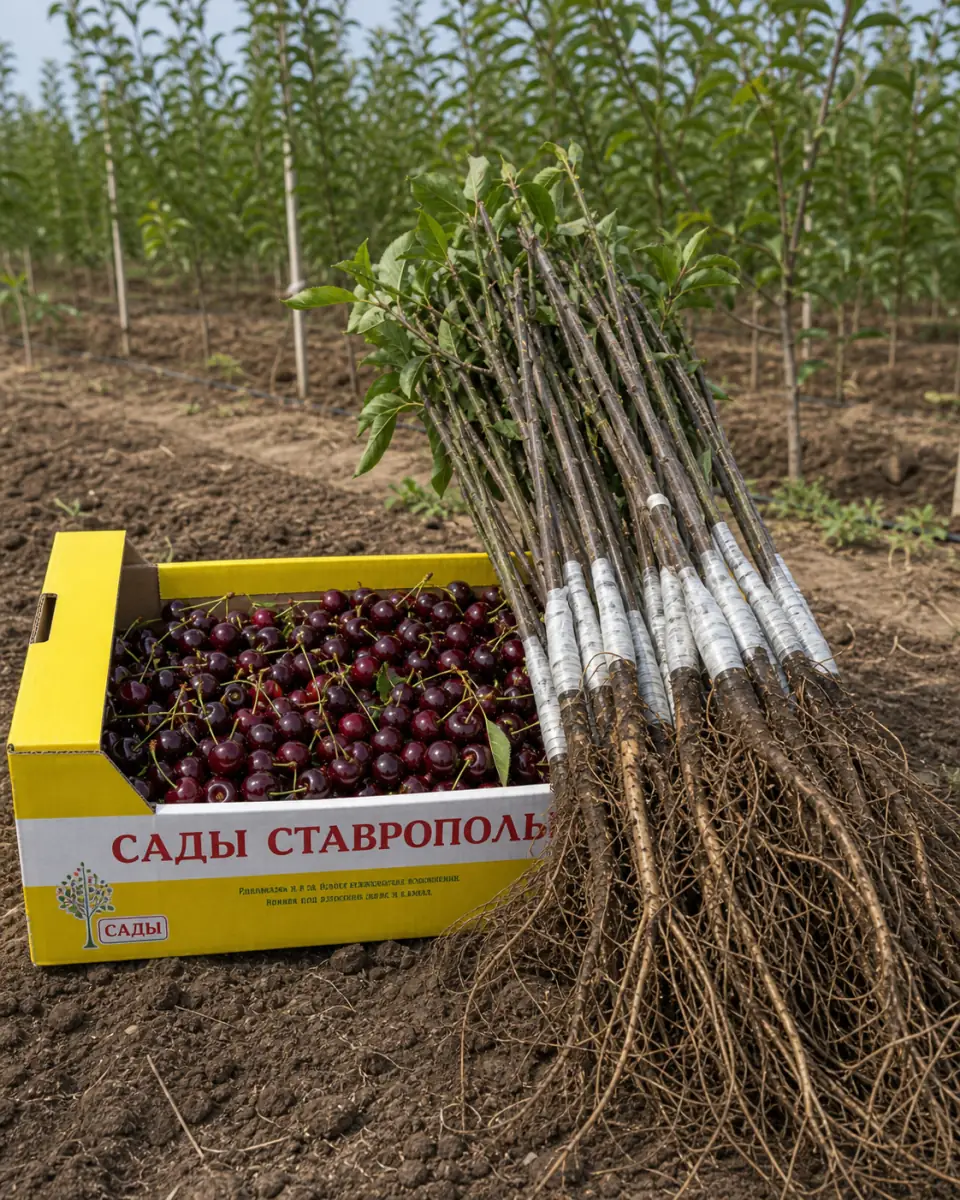
Sweet cherry in southern Russia comes down to three questions. In what order do the cultivars ripen, what pollinates them, and what happens if it rains before harvest. Below they are covered for the five cultivars we have on Gisela 5 and 6. We covered the late Kordia and Regina separately, in the article on pollinizers for Kordia and Regina.
When the five cultivars ripen
Sweet Lorenz ripens well ahead of Lapins, while Samba, Summit and Ferrovia fall in the middle of the season.
Sources count ripening from different reference cultivars. Burlat and Bing serve as the reference points, which is why the table gives each cultivar its own reference instead of one common calendar date. Timing in a given year depends on the weather and the site. You settle it with the agronomist when the orchard is calculated, and a single table is not a basis for laying out a block.
| Cultivar | Ripening | Source |
|---|---|---|
| Sweet Lorenz | About 10 days after Burlat and 8 days before Bing | Plant patent |
| Samba | Medium early to mid-season, according to the breeder-distributor | Graeb sheet |
| Summit | Mid-season, well after Burlat | Excelentes Precios |
| Ferrovia | Mid-May to early June in Puglia, where it is a mid to late cultivar | Wikipedia |
| Lapins | Late, 10-14 days after Bing | Wikipedia |
Fruit size and firmness
The fruit of Sweet Lorenz and Ferrovia is described as the firmest, while Samba and Summit run from medium to firm.
Firmness matters when the fruit goes to a market or a processor rather than being sold at the tree. It affects how the fruit survives transport and how long it keeps after picking. Size is given in the table only where a source names a number.
| Cultivar | Size and shape | Firmness |
|---|---|---|
| Sweet Lorenz | Heart-shaped, mostly about 30 mm, 12-14 g | Very firm, according to the University of Bologna |
| Samba | 29-31 mm, 12-14 g | Medium to firm |
| Summit | Very large, heart-shaped | Medium to firm |
| Ferrovia | Very large, slightly pointed, bright red | Firm, thick skin, travels well |
| Lapins | Large, dark red | Good |
Rain cracking of the fruit
Sweet cherries crack in rain before harvest, and neither cultivar nor rootstock removes that risk completely.
According to Oregon State University, the mechanism is osmotic. The flesh holds about 24 °Brix of dissolved sugars and other solids while rain water carries almost nothing in solution, so water is drawn into the fruit. When a drop stays at the stem or the blossom end, concentric cracks open in the skin. The most dangerous period runs from straw colour to harvest. The details are in the publication EM 9227. Cultivars react to rain differently.
- Samba. Cracking sensitivity is low to medium, according to the distributor Graeb.
- Sweet Lorenz. Sensitivity is medium to low compared with cultivars of the same season, according to the breeder at the University of Bologna.
- Lapins. Most sources describe it as resistant, but Oregon State University rates its cracking as moderate, so it should not be called resistant without qualification.
- Summit. Resistance is fair, according to the description in the Journal of the American Pomological Society.
Rootstock matters too. Gisela 5 and Gisela 6 reduce cracking compared with Mahaleb, the most susceptible rootstock, but the effect depends on the cultivar. Oregon State University names four protective measures.
- Row covers before rain.
- Six calcium sprays, starting at pit hardening.
- Fans or helicopters, but only when the wetting event is shorter than four hours.
- Soil covers between the rows, which cut cracking by up to 25%.
Pollination: four of the five cultivars need a pollinizer
Of our five sweet cherry cultivars only Lapins sets fruit on its own pollen, and the other four need a second cultivar nearby.
Sweet cherry is mostly self-incompatible. Each cultivar has a set of S-alleles, and cultivars with the same set form an incompatibility group, meaning they do not pollinate each other. Cultivars of group 0 act as universal pollen donors.
| Cultivar | Pollination | What is known |
|---|---|---|
| Lapins | Self-fertile | S-alleles S1S4. A good pollinizer for other cultivars. |
| Samba | Self-sterile | S-alleles S1S3, group 2. |
| Sweet Lorenz | Self-incompatible | S-alleles S3S4. Blooms 1-2 days before Burlat. |
| Summit | Self-sterile | Needs a pollinizer; the pair is chosen by alleles and bloom time. |
| Ferrovia | Self-incompatible | Needs a pollinizer; the pair is chosen by alleles and bloom time. |
Lapins is self-fertile and, according to Wikipedia, pollinates other cultivars well, so it is often placed in a block as the donor cultivar. Bloom overlap with its neighbours is still checked separately, and the agronomist picks the partner for Summit and Ferrovia by alleles and bloom time. The scheme “any other cultivar will do” does not work, because cultivars with the same set of alleles cannot fertilise each other.
Gisela 5 or Gisela 6 in the south
In the south each rootstock has its own weak point. Gisela 5 blooms earlier and carries more frost risk, while Gisela 6 is sensitive to heat.
Gisela 5 bears in the second year, but overcropping makes the fruit small, irrigation is essential, and earlier bloom raises the risk of spring frost, as the New York Fruit Quarterly reports. Gisela 6 gives a larger tree and comes into bearing later. According to Oregon State University, this rootstock is sensitive to heat, see the handbook PNW 619. How much that matters on a particular site is decided by the agronomist when the orchard is calculated.
As of 9 October 2026 Samba is available on Gisela 6, and the other four cultivars on both rootstocks. The full comparison is in the article Gisela 5 or Gisela 6.
How to assemble a block and what it costs
A block is assembled from cultivars of several ripening windows, with Lapins planted among them so the others have a pollinizer.
As of 9 October 2026 a sweet cherry sapling on Gisela 5 and 6 costs RUB 800 including VAT. The price list applies from 6,000 saplings in steps of 250 per cultivar. Lots from 1,000 saplings are possible with a surcharge, and we will give the small-lot price in the quote. See stock by cultivar and rootstock in the price list and count trees per hectare in the calculator.
The agronomist helps with the choice of cultivars, rootstock, layout and planting dates. If you are planting apples alongside, their cultivars for the south are covered in the article on apples for the south.
Cultivars in stock
See prices and stock by cultivar in the price list as of 9 October 2026. The lot is handed over on pickup from the village of Sunzha, and for farms in North Ossetia-Alania that is about 200 km in a straight line. Every lot comes with a phytosanitary certificate.
- Lapins on Gisela 5 and 6, self-fertile, late
- Summit on Gisela 5 and 6, self-sterile, mid-season
- Ferrovia on Gisela 5 and 6, self-incompatible, firm skin
- Samba on Gisela 6, self-sterile, medium early
- Sweet Lorenz on Gisela 5 and 6, self-incompatible, ripens well before Lapins
Need a cultivar and pollinizer layout?
Tell us the area and the district, and the agronomist will pick cultivars and rootstock and calculate the lot. We also calculate lots from 1,000 saplings.
The essentials, in brief.
Which sweet cherry ripens first?
Among our five cultivars Sweet Lorenz ripens well ahead of Lapins, about 10 days after Burlat. Lapins is late, 10-14 days after Bing. Samba, Summit and Ferrovia fall in the middle of the season.Does sweet cherry need a pollinizer?
Four of the five do. Only Lapins is self-fertile, while Samba, Sweet Lorenz, Summit and Ferrovia crop poorly without another cultivar nearby. The pair is chosen by S-alleles and bloom time.Which sweet cherry cultivars crack less in rain?
Samba has low to medium cracking sensitivity, Sweet Lorenz medium to low, and Summit fair resistance. Lapins is described as resistant, but Oregon State University rates it as moderate. No cultivar rules out cracking completely.Which rootstock should I choose for sweet cherry in the south?
Gisela 5 blooms earlier and carries more frost risk, and Gisela 6 is sensitive to heat. The choice depends on the site and is checked with the agronomist before planting. The rootstocks are compared in the article on Gisela 5 and Gisela 6.How much does a sweet cherry sapling cost and from what lot size?
As of 9 October 2026 a sweet cherry sapling on Gisela 5 and 6 costs RUB 800 including VAT. The price list applies from 6,000 saplings in steps of 250 per cultivar. Lots from 1,000 saplings are possible with a surcharge, and we will give the small-lot price in the quote.
Related material
- 01Intensive orchard: what it is, layouts, cultivars and costsWhat an intensive orchard is under Government Decree No. 717, how it differs from a traditional one, which layouts and cultivars to count, what the costs consist of and the order of planting.Read article
- 02Gisela 5 or Gisela 6: which rootstock to choose for cherryGisela 5 and Gisela 6 are the two clonal rootstocks an intensive cherry orchard is built on. We cover the differences in vigour, demands and fruiting and help you choose for your conditions.Read article
- 03Sweet cherry cultivars for a commercial orchard: Kordia, Regina and pollinizersKordia and Regina are two late commercial sweet cherries that a commercial orchard is built on. We cover their traits and the main trap — both are self-sterile and need a pollinizer.Read article
Need saplings for your project?
We will match cultivars and rootstocks to your orchard scheme, price a lot from 6,000 units, and set a pickup window — fall 2026 or spring 2027.