Apple cultivars for southern Russia: what to plant in an intensive orchard
Warmth is not scarce in the south, so cultivar choice comes down to heat, frost and scab. We show how to spread 15 M9 cultivars across harvest windows and what to check for each.
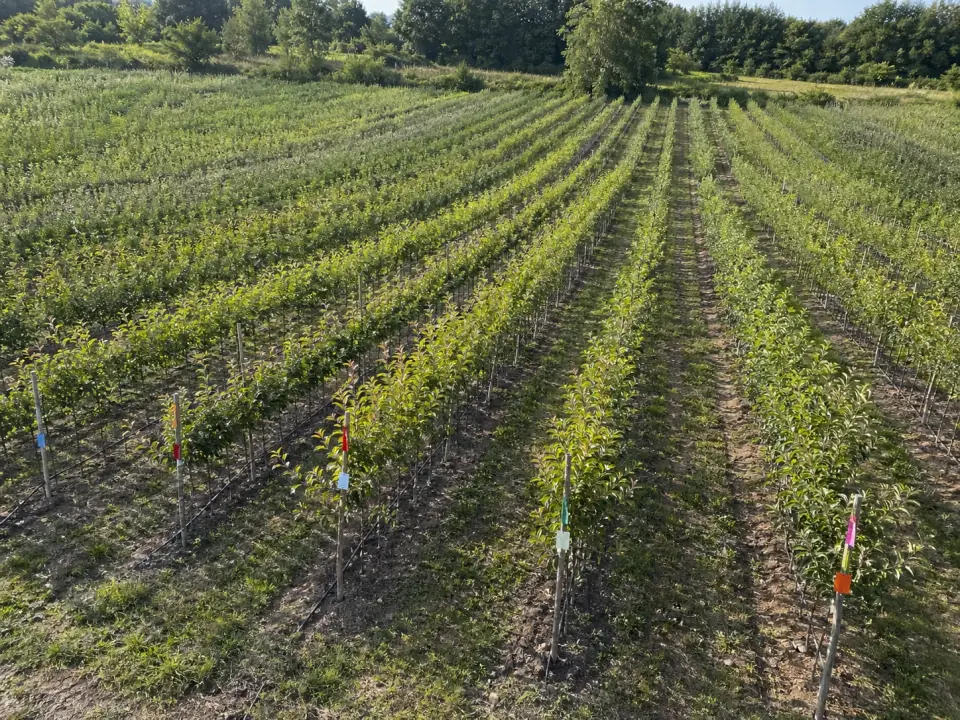
Southern Russia gives apple trees warmth, but the cultivar still has to be chosen with the climate in mind. In summer fruit overheats in the sun, in spring frost takes the blossom, and in wet spells scab attacks the orchard. A cultivar does not remove these risks. It decides how many of them you carry. We covered the general selection criteria in the article on apple cultivars for a commercial orchard. This one covers only what applies to the south.
What limits cultivar choice in a southern climate
Three things limit cultivar choice in the south: fruit overheating in the sun, frost, and scab in wet spells.
Overheating has measured numbers. According to the tree fruit specialist at OMAFRA, the Ontario ministry of agriculture, sunburn starts when the fruit surface holds 45-46 °C for about an hour. Fruit in direct sun, light wind and dry air is 14-17 °C hotter than the air, so at an air temperature near 30 °C it approaches that threshold. The review on onfruit.ca names three protective measures: evaporative cooling by overhead irrigation, kaolin or calcium carbonate on the fruit, and even soil moisture.
Frost has already cut the regional crop. In 2025 Stavropol Krai harvested 71.8 thousand tonnes of apples against 85.3 thousand tonnes a year earlier, 16% less after frosts. This is from the regional minister of agriculture on 24 November 2025, reported by Agroexpert. A cultivar does not protect against cold, it affects something else. A late cultivar may fail to ripen before the autumn cold. Pink Lady, according to Wikipedia, needs a long growing period and a hot climate, and areas with early winter frosts do not suit it.
Scab spoils the look of the fruit. Modì and Inored Story carry the Vf resistance gene, and Crimson Crisp, according to Penn State Extension, is immune to the main scab races in the field. Williams’ Pride is described the same way. Royal Gala and Jeromine are affected by scab. Scab resistance says little about fire blight, and the cultivar ratings for it are collected in the article on fire blight in apple trees.
How to spread cultivars across harvest windows
A southern orchard is easier to run with cultivars from different harvest windows than with one, because the crew and the cold store are then loaded evenly instead of in a single week.
Below are 15 cultivars on M9 in ripening order. It is an order, not a calendar. Dates depend on the year and the site, so discuss the start of harvest for your own block with the agronomist when the orchard is calculated.
| Harvest window | Cultivars | What to consider in the south |
|---|---|---|
| Summer | Geneva, Williams’ Pride | Geneva ripens in midsummer and hardly keeps, so it is sold at once. Williams’ Pride is picked in several passes and keeps only a short time. |
| Early autumn | Gala Devil, Gala Royal, Gala Schniga Red | The early Gala group. Gala Devil and Gala Royal are picked before Golden Delicious. Gala Devil colors red earlier than other early clones, and Gala Royal has no scab resistance. |
| Mid-season | Modì, Jeromine, Golden Delicious Rangers | Modì is picked a little before Golden Delicious, and the cultivar is scab resistant. Jeromine ripens with Golden Delicious and is affected by scab. In Austrian trials Reinders gave a high share of first-class fruit even on unfavourable sites. |
| Mid-late | Crimson Crisp, Ambrosia | Crimson Crisp is immune to scab and holds its fruit on the tree for a long time, so harvest can be stretched. Ambrosia is a mid-late cultivar. |
| Late | Green Star, Fuji, Granny Smith, Inored Story | They need a long warm season. Green Star ripens earlier than Granny Smith. Inored Story ripens after Granny Smith and is scab resistant. |
| Latest | Pink Lady | It needs a hot climate and a long season. Early autumn frost is a risk for it. |
Late cultivars and a long summer
Late cultivars need warmth and a long summer, and the south gives them that, but not on every site.
Granny Smith, according to Wikipedia, needs fewer winter chill hours but a long season to ripen its fruit, so it grows better in a mild climate. Fuji also likes a relatively warm summer. Pink Lady asks for more: a hot climate, a long season and an autumn without early frost, although its chilling requirement is low. In the stock rows Pink Lady is listed for zone Z6-Z9 and most other cultivars for Z5-Z8.
Stavropol sits at roughly zones 6b-7. If autumn frosts come early on your site, discuss the share of late cultivars with the agronomist before planting and give part of the space to mid-season ones. How long late cultivars keep and how to judge maturity for storage is covered in the article on apple cultivars for long storage.
What a cultivar does not solve: hail, moisture and support
A cultivar will not protect an orchard from hail or replace water, so those questions are settled separately from cultivar choice.
As of May 2023 the hail-suppression service of Stavropol Krai protects 839 thousand ha in five districts: Kirovsky, Predgorny, Andropovsky, Kochubeevsky and Shpakovsky. Hail accounts for about 60% of the damage that weather does to the region’s crops, according to pobeda26.ru. If your district is not on the list, build hail protection into the orchard budget.
Moisture also works against sunburn, as OMAFRA notes: even soil moisture lets the tree transpire and cool the fruit. Trees on M9 also need a trellis and irrigation, covered in detail in the article on the M9 rootstock. According to RIA Novosti, in 2021 23 farms in the region received RUB 483 m in subsidies that covered, among other costs, the trellis and anti-hail netting. Current support measures are covered in the article on subsidies for orchard planting.
How to assemble the mix and what it costs
A block is assembled from 3-5 cultivars of different harvest windows, which means one or two cultivars from each window in the table.
Apple trees are self-unfruitful, so cultivars are chosen to pollinate each other. Gala Devil, for example, does not set fruit on its own pollen, and a Greek nursery names Golden Delicious, Granny Smith, Fuji and Jeromine as its pollinizers. The pair must bloom together, which is checked in the calculation. Pollination groups are covered in the article on cultivars for a commercial orchard. The rootstock and planting scheme are explained in the article on M9 and in the calculation of saplings per hectare.
As of 9 October 2026 an apple sapling on M9 costs RUB 360 in grade 1+, RUB 400 in grade 3+ and RUB 450 in grade 5+. The price is the same for every cultivar and includes VAT. The price list applies from 6,000 saplings in steps of 250 per cultivar. Lots from 1,000 saplings are possible with a surcharge, and we will give the small-lot price in the quote. See stock by cultivar in the price list and count trees per hectare in the calculator.
The lot is handed over on pickup from the village of Sunzha. For farms in Stavropol Krai that is about 110 km in a straight line. Saplings are lifted in October and November and in March and April, and every lot comes with a phytosanitary certificate.
Need an orchard calculation for your site?
Tell us the area, the district and the sales channel, and the agronomist will pick cultivars by harvest window and calculate the lot. We also calculate lots from 1,000 saplings.
The essentials, in brief.
Which apple cultivars suit southern Russia?
For the south, cultivars are chosen from different harvest windows with heat, frost and scab in mind. On M9 we have early Gala Devil and Gala Royal, mid-season Modì and Crimson Crisp, and late Granny Smith, Fuji and Inored Story. The exact mix depends on the site and the sales channel.Which apple cultivars are scab resistant?
Of our cultivars on M9, Modì and Inored Story are scab resistant because they carry the Vf gene. Crimson Crisp and Williams’ Pride are immune in the field. Gala Royal and Jeromine are affected by scab.Is Pink Lady suitable for Stavropol Krai?
Pink Lady needs a hot climate, a long season and an autumn without early frost. In the stock rows it is listed for zone Z6-Z9, and Stavropol sits at roughly zones 6b-7. Check a specific site with the agronomist before planting.How many cultivars should a southern orchard have?
A block takes 3-5 cultivars from different harvest windows. That stretches the harvest, and the cultivars cover pollination themselves if they bloom together. We do not advise one cultivar over a whole block.Can I buy fewer than 6,000 saplings?
The price list applies from 6,000 saplings in steps of 250 per cultivar. Lots from 1,000 saplings are possible with a small-lot surcharge, and we will give the price in the quote.
Related material
- 01Intensive orchard: what it is, layouts, cultivars and costsWhat an intensive orchard is under Government Decree No. 717, how it differs from a traditional one, which layouts and cultivars to count, what the costs consist of and the order of planting.Read article
- 02How to choose apple cultivars for a commercial orchardThe cultivar decides who buys your crop and when. We cover the criteria for choosing commercial apple cultivars for an intensive M9 orchard: market, timing, marketability, storage and pollination.Read article
- 03M9 rootstock for apple: traits and when to choose itThe dwarfing M9 rootstock is the backbone of an intensive apple orchard: early fruiting, dense planting, predictable per-tree economics. We cover its traits, schemes and limits.Read article
Need saplings for your project?
We will match cultivars and rootstocks to your orchard scheme, price a lot from 6,000 units, and set a pickup window — fall 2026 or spring 2027.