Orchard on Agricultural Land: How to Use the Plot and Avoid a Fine
Agricultural land cannot sit idle: after three years of non-use a plot can be seized through a court; before that, a fine and an order usually follow. We go through the terms, the amounts and how a planted orchard fits the requirement.
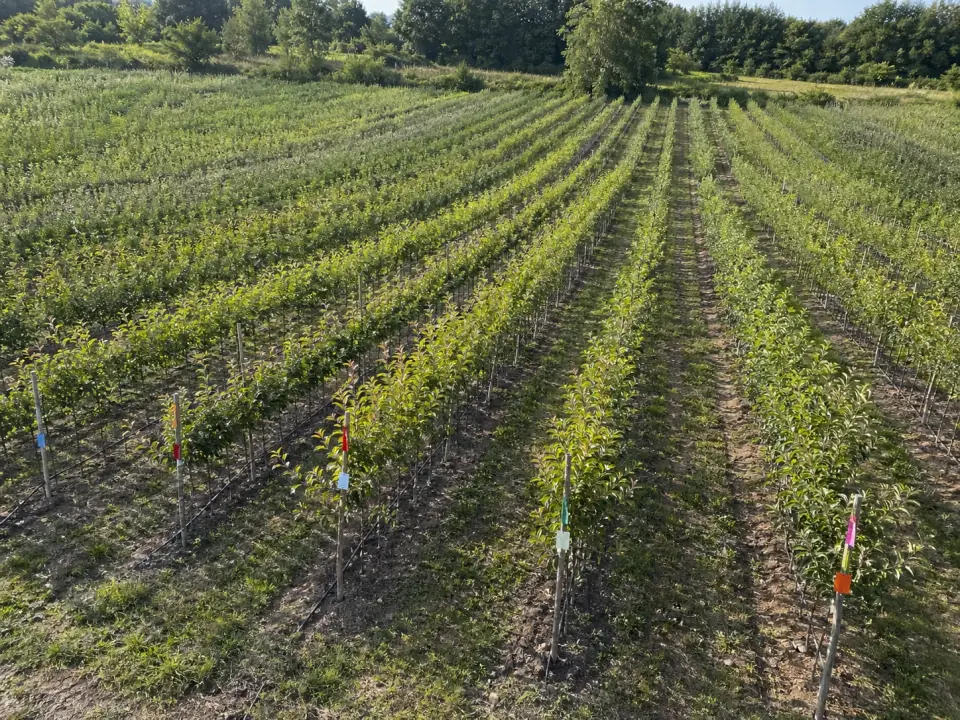
In short: agricultural land must be used for its purpose, otherwise a fine under article 8.8 of the Administrative Offences Code applies and, after three years or more of non-use, a court can order the plot seized and sold at auction. By our reading of Decree No. 1482, laying and caring for perennial fruit crops are named there as work that constitutes activity on a plot intended for horticulture or for growing perennial plantings; this is not an opinion on a specific plot. This is a reference text and not legal advice: check the land category and the permitted use in the Unified State Register of Real Estate (EGRN) extract.
Must an owner use agricultural land?
Yes: article 6 of Federal Law No. 101-FZ “On the Turnover of Agricultural Land” lets a court seize a plot that is not used for its purpose. The grounds are:
- Non-use for the intended purpose for three years or more, found during federal state land control (supervision).
- Use in breach of the law for at least three years in a row from the date the breach was found.
- Use in breach of the law that led to a substantial loss of fertility or to environmental damage.
- A plot bought at auction after seizure is not used for its purpose one year after the purchase.
The development period of the plot counts toward the three years of non-use. Time when natural disasters or other circumstances made use impossible is not counted. What counts as non-use is set by Government Decree No. 1482; its criteria are covered below.
What is the fine for not using agricultural land?
The fine under article 8.8 of the Administrative Offences Code is a percentage of the cadastral value of the plot, subject to a minimum; the amount depends on the part of the article and on the status of the offender. Summary of the article as amended on 04.08.2026:
| Offence | Citizens | Officials | Legal entities |
|---|---|---|---|
| Part 1: use not for the intended purpose | 0.5–1% of cadastral value, at least RUB 10,000 | 1–1.5%, at least RUB 20,000 | 1.5–2%, at least RUB 100,000 |
| Part 2: non-use for agricultural production within the period set by Law 101-FZ | 0.3–0.5%, at least RUB 3,000 | 0.5–1.5%, at least RUB 50,000 | 2–10%, at least RUB 200,000 |
| Part 4: failure to restore land to a condition fit for the intended use (fixed amount) | RUB 20,000–50,000 | RUB 100,000–200,000 | RUB 200,000–400,000 |
Example: a company holds a plot with a cadastral value of RUB 5 million that is not used within the period set by Law 101-FZ. Under part 2 the fine is RUB 200,000 to RUB 500,000: 2% of RUB 5 million is RUB 100,000, which is below the minimum, so the RUB 200,000 floor applies, and the upper limit is 10%.
A sole proprietor is liable as an official (note to article 2.4 of the Administrative Offences Code) unless the Code provides otherwise; under part 2.1 of article 8.8 a sole proprietor is treated as a citizen. Part 2.1 is milder and covers plots bought at auction after seizure. Part 3 concerns land for construction, gardening and vegetable growing with a period of use set by federal law; whether it applies to your plot is for a lawyer to decide.
How is a plot seized and how long does it take?
Seizure happens only by a court decision and only if the breach is not corrected within the period set in the order; the time limits of the individual steps are fixed in paragraphs 4–10 of article 6 of Law 101-FZ.
| Step | Time limit under the law |
|---|---|
| The supervisory body sends the materials to the regional authorities and files a statement with Rosreestr that registration of transactions with the plot is impossible | No later than 10 working days from the date the decision to hold the person liable for ignoring the order takes effect |
| The regional authority applies to court to seize the plot and sell it at auction | Within 2 months of receiving the materials |
| Public auction | Within 4 months of the court decision taking effect |
| Repeat auction if the first failed; starting price 20% lower | No later than 2 months after the first auction |
| Sale by public offer if the repeat auction also failed | No later than 1 month from the day the repeat auction is declared failed |
The starting price at auction equals the cadastral value of the plot. If measures to restore fertility are needed, the price is reduced by their cost, but by no more than 30%. For the owner the decisive document here is the order: complied with on time, it stops the procedure before court.
Does an orchard count as use of the plot?
By our reading, yes: Government Decree No. 1482 names laying, growing and caring for perennial fruit and berry crops as work that counts as activity on a plot intended for horticulture or for growing perennial plantings. The signs of non-use under this decree are:
| Sign | Threshold | How it reads for an orchard |
|---|---|---|
| Overgrowth with listed weeds or with woody and shrub vegetation | 50% of the plot area or more; fruit and berry plantings are not counted as such vegetation | A planted orchard is not overgrowth |
| Turf with interwoven roots of perennial weeds | Depth of 15 cm or more | A sign of an abandoned field, not of a working orchard |
| No agricultural activity on the rest of the area | No activity, or activity on less than 25% of the area | Laying and caring for fruit crops counts as activity on a plot intended for horticulture |
| Heavy weed infestation of planted crops (a sign of use in breach of the law) | Annual weeds above 250 per m², perennial and quarantine weeds above 8 per m² | The orchard must be maintained so that weeds stay below the thresholds |
The first two signs, like spreading land degradation, count as non-use only together with the third: when there is no activity on the rest of the area or it covers less than 25% of the plot. Parts of the plot with buildings, protective forest belts and water bodies are not counted, nor is land under fallow for no more than two years. This is our reading of the decree and not an opinion on a specific plot: ask a lawyer how the supervisory body applies the criteria.
Since 1 March 2026 landowners have been required to take measures to protect land from the spread of dangerous invasive plants and to destroy them (Federal Law of 31.07.2025 No. 294-FZ), so factor this into orchard upkeep.
Which permitted use does an orchard need?
The Rosreestr classifier provides code 1.5 “Gardening” for an orchard: activity connected with growing perennial fruit and berry crops, grapes and other perennial crops. The classifier was approved by Rosreestr Order No. P/0412 of 10.11.2020.
In the classifier the content of “Agricultural use” (1.0) and “Crop production” (1.1) includes, among others, gardening. If the EGRN extract shows a narrow type, for example “Growing grain and other agricultural crops” (1.2), discuss a change of permitted use with a lawyer before planting: the procedure and timing depend on the plot.
What to do in practice: from plan to planting
The order is: EGRN extract, orchard plan, sapling calculation, an order placed for the planting window, and maintenance of the orchard after planting.
- Order an EGRN extract and check the land category, permitted use, area and cadastral value.
- Decide the area for the orchard and the planting layout. The sapling calculator returns the number of trees and the lot cost, and prices are in the price list.
- Estimate the budget per hectare using the articles “How much does a hectare of orchard cost” and “Apple orchard as a business”.
- Choose the species, cultivars and rootstock together with an agronomist, for example knip apple on M9, and order saplings for the lifting window: October–November or March–April.
- Check the planting material documents using the article on documents for saplings and the state support terms: subsidies and the unified grant.
Saplings are collected from the nursery in the village of Sunzha, and a phytosanitary certificate comes with each lot. The minimum lot is 6,000 saplings, which is about 2.5 hectares at a 3.5 × 1.2 m layout.
The nursery agronomist advises on cultivars, rootstocks, layouts and planting dates. On request we prepare a turnkey orchard project together with partner contractors: design, site preparation, trellis, irrigation and planting. Scope, price and regions are quoted on request. Nursery page for the region: Stavropol Krai.
Need a lot calculation or agronomist advice?
Send the area, the species and the planting layout. We will return the number of trees with a reserve and the lot cost at list prices, and advise on cultivars and timing. The minimum lot is 6,000 saplings, small lots start from 1,000, and the price of a small lot is given in the quote.
Sources
- Federal Law of 24.07.2002 No. 101-FZ “On the Turnover of Agricultural Land”, article 6, text as of 9 November 2026
- Code of the Russian Federation on Administrative Offences, article 8.8, as amended on 04.08.2026
- Government Decree of 18.09.2020 No. 1482 “On the signs of non-use of agricultural land plots”, text on government.ru
- Federal Law of 31.07.2025 No. 294-FZ “On Amendments to the Land Code of the Russian Federation and Certain Legislative Acts of the Russian Federation”, text on Garant, in force from 1 March 2026
- Rosreestr Order of 10.11.2020 No. P/0412, classifier of permitted land uses, code 1.5 “Gardening”
- Price list of the Sady Stavropolya nursery for autumn 2026 and spring 2027, stock as of 9 October 2026
The essentials, in brief.
After how many years can agricultural land be taken away?
A court can seize a plot if non-use is found during land control and lasts three years or more. The development period counts toward those years, and time of natural disasters is not counted. Seizure is preceded by an order and an administrative penalty for failing to comply with it.What is the fine for not using agricultural land?
Under part 2 of article 8.8 of the Administrative Offences Code: 0.3 to 0.5% of the cadastral value for citizens (at least RUB 3,000), 0.5 to 1.5% for officials (at least RUB 50,000) and 2 to 10% for legal entities (at least RUB 200,000). A sole proprietor is liable as an official unless the Code provides otherwise.Does a planted orchard count as use of the land?
In Decree No. 1482, laying, growing and caring for perennial fruit crops are named as activity on a plot intended for horticulture, and fruit plantings are excluded from the woody and shrub vegetation that serves as a sign of non-use. This is our reading; ask a lawyer about the status of a specific plot.Which permitted use does a fruit orchard need?
In the Rosreestr classifier it is code 1.5 “Gardening”. If the EGRN extract shows a narrow type, for example growing grain, check with a lawyer before planting whether the type must be changed.Can I plant an orchard on a plot that used to grow grain?
An orchard remains agricultural use if the permitted use in the EGRN allows it. Check the type, calculate the layout and the number of trees in the calculator and order saplings for the planting window: October–November or March–April.Is the fine cancelled if I plant an orchard?
Not automatically. The fine relates to a past period, and the order must be complied with within the set time. Planting and care remove the cause of the breach, but how the supervisory body treats it depends on your case: consult a lawyer.
Related material
- 01Apple Orchard as a Business: Where to Start and What to CalculateThe path from the plot to the first crop, a list of what to calculate before planting, public cost benchmarks with sources and the risks: frost, hail, sales and the years without revenue.Read article
- 02Subsidies for laying an intensive orchard in 2026–2027What is known about subsidies for laying and caring for an orchard: the scope of support, density coefficients, Stavropol Krai figures for 2025 and 2026 and a checklist for a sapling buyer.Read article
- 03Intensive orchard: what it is, layouts, cultivars and costsWhat an intensive orchard is under Government Decree No. 717, how it differs from a traditional one, which layouts and cultivars to count, what the costs consist of and the order of planting.Read article
Need saplings for your project?
We will match cultivars and rootstocks to your orchard scheme, price a lot from 6,000 units, and set a pickup window — fall 2026 or spring 2027.